John Brown Quotes
Slavery has beene permitted by the Supreeme Governour of all things for time Immemorial, and whenever I am Convinced as you are, that its Wrong in the Sight of God, I will Immediately Desist, but while its not only allowed by the Supreeme Governour of all States but by all the Nations of Europe...I cannot thinke this State ought to Decline the trade.
Brown was then a member of the state legislature representing Providence. He was also himself a ship owner in the slave trade and he was the brother of the leading Rhode Island abolitionist, Moses Brown. See {585793}. John Brown became the first American, prosecuted in federal court for illegal slave trading –-- a prosecution brought, in part, by his own brother, Moses. He was acquitted.
John Brown, 1736–1803, U. S. Congressman (Federalist, RI), Member of the Continental Congress, Merchant & Shipping Magnate & Slave Trader, Argument defending the business of slavery, Rhode Island Assembly, November 1786
Sourced by: Eigen's Political and Historical Quotations

His family was one of the wealthiest in Rhode Island. He called in the entire family and he formally read the deed. The family itself had actually been active in the slave trade under John, his oldest brother, so this deed was very shocking to them. Moses became a leading abolitionist in Rhode Island and John the major defender of slavery in the state. Despite that, the brothers actually remained close.


He was also himself a ship owner in the slave trade and he was the brother of the leading Rhode Island abolitionist, Moses Brown. See {585793}. Brown became the first American, prosecuted in federal court for illegal slave trading –-- a prosecution brought, in part, by his own brother. He was, however, acquitted.


It was then the practice of some men to engage in an attempted moral justification of slavery, including, in many cases, resorting to Biblical scripture and principles to argue that slavery was the will of God.

The “lords of the lash” were the Southern slave owners. The “lords of the loom” were the Northern mill owners. The Southern cotton, grown by cheap slave labor was sold to the Northern mill owners at very low prices. They in turn wove the cotton into cloth and sold it throughout the nation and to foreign countries. So, although there was strong Northern anti-slavery sentiment, the wealthy and politically powerful mill owners had a vested interest in maintaining slavery in the South.


Indian and Black slaves were outlawed very early in Connecticut, not on moral grounds of concern for the Indians and Blacks, but because of the negative effects on the white poor. Why would anyone pay the poor any more than the amortization costs of a slave? Therefore there was no way a poor white could make a living wage if slavery were to coexist.
Downing was the brother-in-law of the Governor. Many people think that the Puritans were very moral people but they were not that so much as rigid. There was no moral compunction for example against slavery as this letter shows.

The cotton industry and slavery were a very important part of the economy of Providence, RI. The Rhode Island cotton mills were supplied by Southern cotton produced by slaves and carried from the South on Rhode Island ships. Many of the southern slaves were kidnapped from Africa from Rhode Island slave trading ships. When the slave trade was made illegal, Brown was the first slave trader prosecuted. His brother, Moses Brown, a vehement abolitionist was one of the men who brought the prosecution.


A few years later he had a clearer idea of what was to be done. However, the additional factor of the Civil War played a big part in driving his Emancipation Proclamation. See {609360}


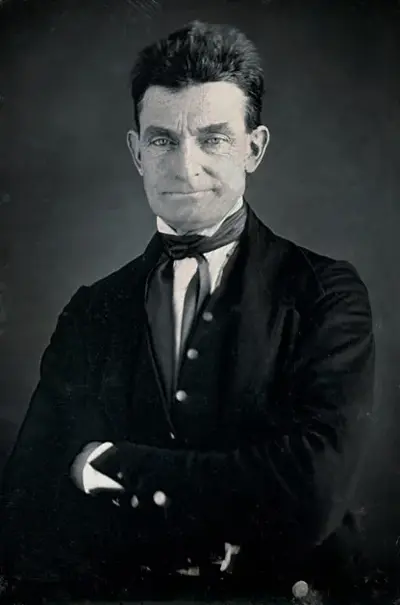
- Born: May 9, 1800
- Died: December 2, 1859
- Nationality:
- Profession: Tanner; Cattle, Horse, Sheep Breeder Trader; Farmer
John H. Brown was an American abolitionist leader. Brown felt that violence was necessary to end American slavery, as years of speeches, sermons, petitions, and moral persuasion had failed.
