Andrew Fletcher Quotes
Scotland will be only fit for the slaves who sold it.
The Union was ratified by the Nobles of Scotland despite widespread public opposition. There were substantial financial incentives in the terms of the Union for the leading nobles and members of Parliament.
Andrew Fletcher, 1653-*, Scottish Member of Parliament and Soldier, Statement upon emigrating from Scotland after Union with England, 1707
Sourced by: Eigen's Political and Historical Quotations

This speech was officially prepared and read to the six Indian tribes of the Iroquois Nation. The purpose was to persuade the Iroquois Indians to stay neutral (see {583726}) in the coming conflict with England. The Iroquois had traditionally traded peaceably with the colonists and on many occasions the colonists and the Iroquois had fought against the French and other Indians. Unfortunately, a Mohawk chief, Joseph Brant, had traveled to England and been educated there. He, following the conventional wisdom of the day persuaded most of the Iroquois tribes to join the obvious winner—England—and fight on their side. Only the Oneida tribe resisted Brant’s advice, and joined the revolutionists. The result was a civil, fratricidal war of not only white, but also the Iroquois Indians who had been at peace with each other since any could remember. When the colonists won, the Oneida were warmly embraced and participated in New York and other colonial life and activities. The relationship was so good that a little over 200 years later the average earnings of the Indian in New York State exceeded that of the average white man. The other 5 Iroquois tribes however were attacked and driven out of their traditional territories and they fled with Joseph Brant to English Canada where they have not yet fully recovered their important place in the society.

unions and federations of two countries


Colonization of Blacks back to Africa The first anti-slavery newspaper published in the United States & the first journal in America to advocate immediate, unconditional emancipation


Barre, who had served as an officer in North American fighting with the Americans against the French, was a major opponent of the Stamp Act and other efforts to tax the American colonies. In the debate one of his opponents referred the American colonies as “planted by the care of England” and “nourished” by the mother country’s care. Barre was imprisoned in the Tower of London for a while for his vigorous defense of the American colonists.


Two months earlier, Jinnah and the Muslim League had, behind the scenes, orchestrated and abetted vicious, murderous, terrorist attacks on Sikhs by Muslim tribesman brought into the Punjab for the purpose." Master Tara Singh

It was then the practice of some men to engage in an attempted moral justification of slavery, including, in many cases, resorting to Biblical scripture and principles to argue that slavery was the will of God.

The Parliament was debating the reaction to the Stamp Act by the American Colonies. One of the members, reflecting a majority view, asked sarcastically when the American Colonies had been emancipated so that they could make their own independent decisions. Pitt then hit this one out of the park by reversing the question.

Galloway, had campaigned against Blair and the Labor Party and had beaten the Labour MP in his district which was predominantly Muslim. He had been vehemently opposed to the Iraq War.

In Russia at the time, serfs were little better off than slaves. Not only did they have to obey their landlords in all things, but any who advocated disobedience on their part were beaten and sent to Siberia. Exile to the Siberian Gulags was not an invention of the Communists of the 20th century although they used that punishment in unprecedented numbers. It was used by the Czars and the Empress.

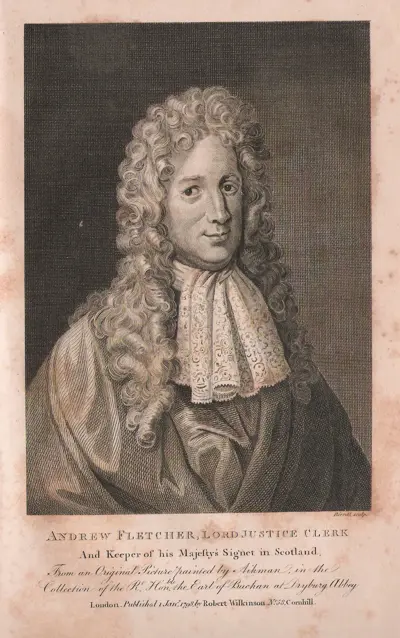
Andrew Fletcher of Saltoun was a Scottish writer and politician, remembered as an advocate for the non-incorporation of Scotland, and an opponent of the 1707 Act of Union between Scotland and England. Fletcher became an exile in 1683 after being accused of promoting insurrection. He was appointed the cavalry commander of the Monmouth Rebellion, but shortly after landing in England he killed another leading figure. He again went into exile, this time as a fugitive and with his estates forfeit. He returned with William of Orange, becoming Commissioner of the old Parliament of Scotland.
