William Tecumseh Sherman Quotes
Said Indians, further expressly agree: ….That they will not attack any persons at home or traveling, nor molest or disturb any wagon trails, coaches, mules or cattle belonging to the people of the United States, or to persons friendly therewith. That will never capture or carry off from the settlements women or children. They will never kill or scalp white men, nor attempt to do them harm. They will not in future oppose the construction of railroads, wagon roads, mail stations, or other works of utility or necessity which may be ordered or permitted by the laws of the United States; but should such roads or other works be constructed on the lands of their reservation, the government, will pay the tribe whatever amount of damage may be assessed by three disinterested commissioners to be appointed by the President for that purpose, one of said commissioners to be a chief or head man of the tribe.
William Tecumseh Sherman, 1820-1891, General of the Army & Indian Peace Commissioner, Barboncito, 1820-1871, Navaho Indian Chief, Navaho Treaty, 1868
Sourced by: Eigen's Political and Historical Quotations


See {633119} for the basic provision of the Dawes Act.

Wayne played so many parts depicting whites in the process of expanding Westward that many people saw him as an expert on the history of the Westward Expansion. He did not comment on the whites who then kept huge ranches “selfishly” for themselves or those who selfishly would not share the mineral rich land that they had taken with anyone including the original Indian owners. So in this view, the Indians should have not been capitalists but they should have been socialists and shared their resources.


At the time, Palestine was technically Turkish territory. Turkey was one of the defeated axis powers in World War I. England, as part of the World War I peace treaties, had control over Palestine as well as most of the rest of the Middle East.

When whites first came to America, the Iroquois, were the most sophisticated Native Americans. They were actually a confederation of 5 different tribes each of which was composed if many clans. Although fierce warriors, they had agreed not to fight each other and to assist if any were attacked. They developed a strong agricultural base, to go with the fishing and hunting, and their confederation were very aggressive and sophisticated traders taking them far from their upstate New York “capitol.” Their governmental structure was quite sophisticated with an elaborate, formal, system of checks and balances, multi-cameral legislatures that recognized numbers of citizens, power and wealth, and even cultural traditions. They were literate, capitalistic and globalistic in that they wanted to trade with all. They had written laws, and women had a role that was unique in world history in that only women owned property in a matrilineal society. Further, it was only the Clan Mothers who voted for the 50 Sachems (~Senators)—but their selections had to be accepted by the people they represented. Ironically the descendants of the Iroquois who remained in New York became a very successful Native American group. In the 2000 census, the average Indian in New York State earned the same income as the average White with no Indian gambling money.

Chivington led troops to attack hostile Indians. When they arrived at Sand Creek, the most militant young Indian men had left. The others did not want to fight, displayed white flags and wanted to negotiate. Chivington made his famous statement, attacked the Indians and massacred most of them including the ones who were trying to surrender with white flags. See {597566}.


In 1908 Austria had designs on the Balkans, whose small countries have been fought over for years.

In the midst of the French & Indian Wars, the Board of Trade drafted the royal proclamation of October 7, 1763, forbidding the granting of lands in the vast interior, which was specifically reserved to the Indians. Most whites, themselves interested in land, saw this as a temporary expediency only. This quotation must be viewed in juxtaposition with his of 1767 on the subject: {624055}


By 1887 the government behavior towards Indians had come far from the Andrew Jackson days of Indian Removal and the government and reformers were trying to do better with Indian policy. This law was very well intended, and yet angered some Indians and tribes Where there was good agricultural or grazing land, the law required that the land be divided amongst the individual Indians who would thereafter own the deed and control the land. The problem had been that there was no concept of individual land ownership in most tribes. There were no deeds and whites would buy land unknowingly (and sometime knowingly who claimed to (or did) speak for the tribe. With this law, farm and grazing land would pass to the ownership of individual Indians. There are over 500 different Indian tribes—nations in America and they are very diverse. This law was good for some tribes and negative for others. With no communal say in the use of the land, the reservation was like a white farming community where the individual was dominant and not the town, group or culture. It minimized the dependency that Indians had on each other and the group. Within individual tribes there were often those Indians who preferred collective ownership and those who preferred individual ownership as provided in this legislation.

Note that there was still a serious attempt to coexist with the Indians and to pay for lands that whites moved into. This would change radically in the administration of Andrew Jackson who would replace Adams.

Jackson’s policies regarding Indians set back all the work of the earlier Presidents and created facts on the ground and attitudes that vex us to this day. In this occasion he said very forthrightly that it was his intention to deny Indians title to ANY land in the then United States. His idea was to send all the Indians to the Oklahoma Indian Territory and establish reservations for them there. Of course, as the Western states joined the Union, the Whites wanted those Indian Lands as well. See {643150} for other Jackson views on Indian policy.


Most of her modern admirers tend to repress this quotation which is very embarrassing for most modern conservatives. However, there is a minority of thinkers who maintain that land, unused, is open to anyone who will make use of it to improve civilization. Many conservationists, in contrast, extol unused land for preservation.


a Shoshone Indian woman who accompanied Lewis and Clark in exploring the Louisiana Territory

Hull surrendered a few days later.
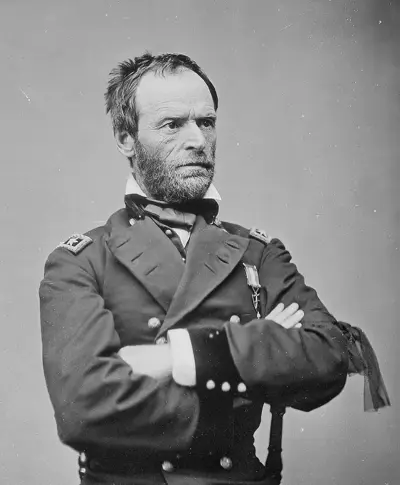
William Tecumseh Sherman was an American soldier, businessman, educator, and author. He served as a general in the Union Army during the American Civil War (1861–1865), receiving recognition for his command of military strategy as well as criticism for the harshness of the scorched earth policies he implemented in conducting total war against the Confederate States. British military theorist and historian B. H. Liddell Hart declared that Sherman was "the first modern general".
