Red Jacket Quotes
We have looked back, and remembered how the Yorkers purchased our lands in former times. They bought them, piece after piece – for a little money paid to a few men in our nation, and not all our brethren – until our planting and hunting grounds have become very small, and if we sell them, we know not where to spread our blankets.
Red Jacket, 1751-1830, Seneca Indian Chief, 1811
Sourced by: Eigen's Political and Historical Quotations

The century to which he was referring was the 19th century---1800-1899.

The central Indian policy problem for Jefferson’s Administration was the fact that most Indians hunted for subsistence and the amount of land needed to support a hunting society was per capita much greater than an agricultural and especially an industrial one. Jefferson had no personal animosity against the Indians as many in his day did. But he perceived the need to obtain Indian lands for white agricultural use.


The line, like many in good poetry, has several levels of meaning. The most obvious is that we had explored and conquered the land, before we became a nation.

Wayne played so many parts depicting whites in the process of expanding Westward that many people saw him as an expert on the history of the Westward Expansion. He did not comment on the whites who then kept huge ranches “selfishly” for themselves or those who selfishly would not share the mineral rich land that they had taken with anyone including the original Indian owners. So in this view, the Indians should have not been capitalists but they should have been socialists and shared their resources.

Most of her modern admirers tend to repress this quotation which is very embarrassing for most modern conservatives. However, there is a minority of thinkers who maintain that land, unused, is open to anyone who will make use of it to improve civilization. Many conservationists, in contrast, extol unused land for preservation.


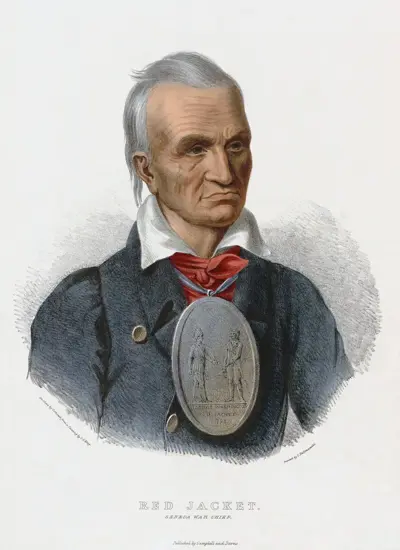
Red Jacket (known as Otetiani in his youth and Sagoyewatha [Keeper Awake] Sa-go-ye-wa-tha as an adult because of his oratorical skills) was a Seneca orator and chief of the Wolf clan, based in Western New York. On behalf of his nation, he negotiated with the new United States after the American Revolutionary War, when the Seneca as British allies were forced to cede much land following the defeat of the British; he signed the Treaty of Canandaigua (1794). He helped secure some Seneca territory in New York state, although most of his people had migrated to Canada for resettlement after the Paris Treaty.
