Tecumseh Quotes
There cannot be two occupants in the same place. The first excludes all others. It is not so in hunting or traveling; for there the same ground will serve many as they follow each other all day; but the camp is stationary and that is occupancy. It belongs to the first who sits down on his blanket or skins, which he has thrown on the ground, and till he leaves it no other has a right.
Tecumseh, 1768-1813, Shawnee Indian leader, 1810
Sourced by: Eigen's Political and Historical Quotations


President-elect Kennedy had asked the poet to write and present a poem for the inaugural.

Arguing that the Arabs will never agree willingly to a Jewish state:

The line, like many in good poetry, has several levels of meaning. The most obvious is that we had explored and conquered the land, before we became a nation.


The Romans were very organized regarding land ownership. When they conquered Africa, defeating Carthage, they found no written records of land ownership, no deeds, no bills of sale. Therefore, they opened up the entire land mass of Africa for what amounted to public colonization where the land could be worked and claimed legally. Illiterate Africans had no written records, and most areas where under the control of a strongman who “owned” all of the land with no notion of private ownership of land.

Earlier, treaties had been negotiated whereby whites purchased certain Indian lands. Tecumseh and others had objected not only to the concept of land sale, but to those who had sold the lands {612650}.


The Bushmen are of the indigenous people of Botswana who have only had extended contact with the larger world recently.

The whites had constantly encroached on the Cherokee land which was too large for any reasonable patrolling by the Indians themselves. The Federal government persuaded the Cherokee to sign a treaty by which the Indians would give up their title to the larger part of their land. The most important quid pro quo was that the Federal Government would protect the remainder of the Cherokee land from incursion by whites or even other Indians. However, whites who coveted the land started to encroach and build farms and ranches. The Federal government was reluctant to use American soldiers against American citizens and was looking for a way out. However, the Cherokee chiefs were reminding them of their obligation. The state governments were less concerned about Federal treaties, and Georgia passed a law that said that all the Cherokee land must be governed by State Law contrary to the Treaty which gave the Cherokee total sovereignty. But the Feds were not anxious to have a showdown with the states on this issue. Whites, with the connivance of the state governments and the support of some Federal Officials offered to amend the treaty with the Cherokee. The whites would pay the Indians fair market value for their land in the East. The Federal Government would provide equal amount of land in the Indian Territory of Oklahoma, then a territory. The Feds would assist with the relocation and provide troops to protect the Cherokee from thieves and raiders—whites and Indians, and would guarantee that the Cherokee would be completely sovereign in the new land. The chief’s did not want to renegotiate the old treaty—they just wanted it enforced. The Supreme Court ruled in their favor, but President Jackson, ignored the ruling and forced the Cherokee onto the Trail of Tears for Oklahoma and the whites took over the valuable Cherokee land.

See {638124} for how this Biblical passage evolved into a concept of property ownership

The century to which he was referring was the 19th century---1800-1899.

There was then legislation proposed to to nullify a number of Indian treaties. Indians themselves were divided as to the desirability. Mrs. Roosevelt favored negotiations and discussions with each tribe separately regarding their treaties as opposed to the proposed legislation which treated the tribes monolithically when indeed they were 500 separate tribes with different cultures, needs and desires.


In every society where there had been past unjust ownership of land, all efforts of land reform were faced with the problem of having to dispossess the current “owners” who themselves had not been guilty of the crimes of their ancestors in unjustly obtaining the land originally. In America land reform was unworkable in most cases and the solution was usually a large monetary payment as compensation for the land.
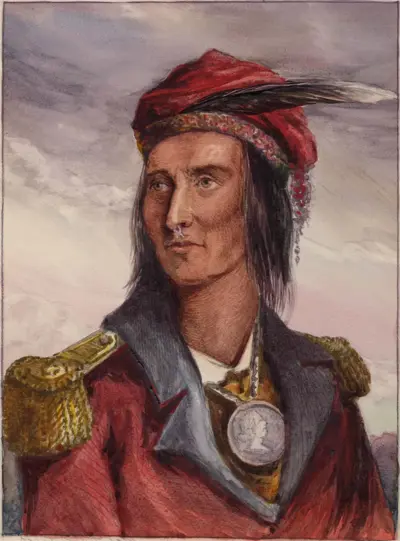
Tecumseh was a Shawnee chief and warrior who promoted resistance to the expansion of the United States onto Native American lands. A persuasive orator, Tecumseh traveled widely, forming a Native American confederacy and promoting inter-tribal unity. Although his efforts to unite Native Americans ended with his death in the War of 1812, he became an iconic folk hero in American, Indigenous, and Canadian popular history.
