Quanah Parker Quotes
I do not talk English very much… I go down Washington… Government wants to open the Indian country. Indian he no ready yet, maybe half of it, they ready. That’s what I come for. That’s what I tell commissioner.
Quanah Parker, 1852-1911, Comanche Indian Chief, 1896
Sourced by: Eigen's Political and Historical Quotations


This is one of the first Policy Statements of the new Republic about the Indians. Essentially, although the government policy was reasonable and fair, public opinion was totally different and the leadership could not persuade the people on this point. One complicating factor was the fact that most of the Indian tribes had overtly or covertly sided with the British in the Civil War. Many Indians were exiled to Canada. Even the Indians who were American allies, had their lands encroached upon however.
The intentions of the Founding Fathers towards the Indians was decent, respectful, and well intentioned. However, there was not enough of a system of enforcement or the will to enforce when the greed of the average whites grew too great. Many settlers saw these vast lands and could not see any harm in using a few acres for their farm. And if there had been only a few, there would have been little trouble. However, the settlers kept coming and coming and soon the Indians began to push back. In a sense, it was a class problem. The members of the Continental Congress who wrote the Northwest Ordinance were educated, affluent men who had plenty of land. Most of the men who contested for the Indian lands had little land or were newly affluent and saw few limits to America.


Large wagon trains of settlers crossed the content on their way to the Oregon Territory. The Sioux Indians whose land the wagon trains had to pass through often attacked the wagon trains in a vain effort to discourage others from passing through the area. The Sioux believed that the large wagon trains frightened the buffalo away, which was probably not a significant factor in the diminishing of the buffalo herds. The Indians and white hunters both over-hunted the buffalo which became few in numbers. With modern wildlife management Buffalo are not only back but are plentiful and being raised for their lean meat which has become a delicacy.

Marshall was in general very sympathetic with the Indians and their rights, but even for him the notion of treating the Indians as sovereign masters of all their lands was unthinkable.


The White Africaners were attacking the Blacks to force them off their land so the Afrkaners could take over. The country was under British rule and the unarmed Blacks were being slaughtered by the Afrikaners who were British Subjects. Eventually the Boer War set the English against the Afrikaners. See {583902} for a related quotation.

While Jefferson was clear on this point, there were other forces and points of view that did not recognize Indian rights and were prepared to use force to obtain Indian lands. These, together with some Indians who made bad and sometimes corrupt bargains and treaties ceding land, produced the loss of most of the Indian land in America.
The central Indian policy problem for Jefferson’s Administration was the fact that most Indians hunted for subsistence and the amount of land needed to support a hunting society was per capita much greater than an agricultural and especially an industrial one. Jefferson had no personal animosity against the Indians as many in his day did. But he perceived the need to obtain Indian lands for white agricultural use.


Cass was negotiating with the Shawnees and Cherokees to persuade them to move to land west of the Mississippi. See John Henry Eaton for similar unkept promises.

Justification for policy of settling all Indians west of the Mississippi River.

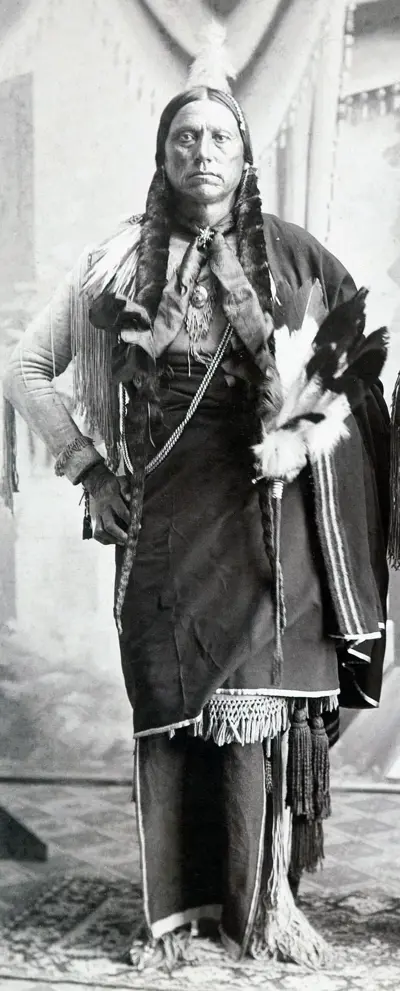
Quanah Parker (Comanche kwana, "smell, odor") was a war leader of the Kwahadi ("Antelope") band of the Comanche Nation. He was likely born into the Nokoni ("Wanderers") band of Tabby-nocca and grown up among the Kwahadis, the son of Kwahadi Comanche chief Peta Nocona and Cynthia Ann Parker, an Anglo-American who had been kidnapped as a child and assimilated into the Nokoni tribe. Following the apprehension of several Kiowa chiefs in 1871, Quanah Parker emerged as a dominant figure in the Red River War, clashing repeatedly with Colonel Ranald S. Mackenzie. With European-Americans hunting American bison, the Comanches' primary sustenance, into near extinction, Quanah Parker eventually surrendered and peaceably led the Kwahadi to the reservation at Fort Sill, Oklahoma.
