Sitting Bull Quotes
Therefore, I do not wish to consider any proposition to cede any portion of our tribal holdings to the Great Father.
Utley, Robert M. The Lance and the Shield: The Life and Times of Sitting Bull. Henry Holt and Company, 1993, p. 268.


The central Indian policy problem for Jefferson’s Administration was the fact that most Indians hunted for subsistence and the amount of land needed to support a hunting society was per capita much greater than an agricultural and especially an industrial one. Jefferson had no personal animosity against the Indians as many in his day did. But he perceived the need to obtain Indian lands for white agricultural use.


Jackson’s policies regarding Indians set back all the work of the earlier Presidents and created facts on the ground and attitudes that vex us to this day. In this occasion he said very forthrightly that it was his intention to deny Indians title to ANY land in the then United States. His idea was to send all the Indians to the Oklahoma Indian Territory and establish reservations for them there. Of course, as the Western states joined the Union, the Whites wanted those Indian Lands as well. See {643150} for other Jackson views on Indian policy.


While Jefferson was clear on this point, there were other forces and points of view that did not recognize Indian rights and were prepared to use force to obtain Indian lands. These, together with some Indians who made bad and sometimes corrupt bargains and treaties ceding land, produced the loss of most of the Indian land in America.

Large wagon trains of settlers crossed the content on their way to the Oregon Territory. The Sioux Indians whose land the wagon trains had to pass through often attacked the wagon trains in a vain effort to discourage others from passing through the area. The Sioux believed that the large wagon trains frightened the buffalo away, which was probably not a significant factor in the diminishing of the buffalo herds. The Indians and white hunters both over-hunted the buffalo which became few in numbers. With modern wildlife management Buffalo are not only back but are plentiful and being raised for their lean meat which has become a delicacy.


Cass was negotiating with the Shawnees and Cherokees to persuade them to move to land west of the Mississippi. See John Henry Eaton for similar unkept promises.

In the only presidential Special Message to Congress on the subject of Indians in American history:


The treaty was signed by a number of people including the Navajo leaders but Sherman or his staff drafted most of it. Sherman also had the title then of Indian Peace Commissioner. This clause, together with Article V, {617991} guaranteed the territorial integrity to into the 21st century. The super majority requirement was key, preventing what happened to many other Indian land holdings which were sold off by individuals or so called chief’s who were not really representing the majority of the tribe.


Note that there was still a serious attempt to coexist with the Indians and to pay for lands that whites moved into. This would change radically in the administration of Andrew Jackson who would replace Adams.

The Indians did not have the wheel when the whites came, but soon there were wagons, stage coaches and railroads.

He was a brutal officer who by modern standards committed various war crimes.

Most of the Colonies had laws against Indians possessing guns and any white seeing such was allowed to attack such Indians. Rhode Island had peaceful relations with the Indians and not only allowed Indians to carry firearms for hunting but hired them to do the hunting as they were better at it and did not value their time as highly as the whites. However, travelers coming from out of the colony would see an Indian with a gun, and shoot at him thereby killing or injuring friendly Indians and causing racial problems when there were few. The quotation also illustrates that there was little uniformity amongst the colonies as to how to deal with their various social and political problems.

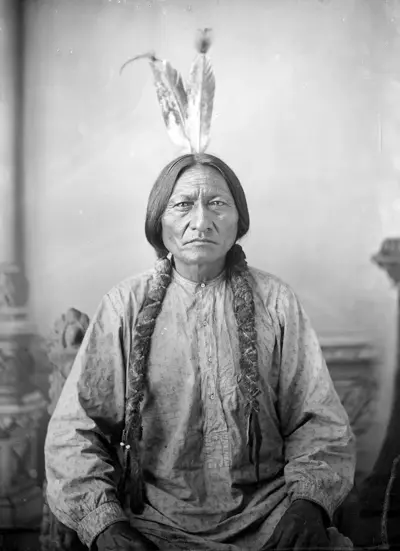
Sitting Bull was a Hunkpapa Lakota leader who led his people during years of resistance against United States government policies. He was killed by Indian agency police on the Standing Rock Indian Reservation during an attempt to arrest him, at a time when authorities feared that he would join the Ghost Dance movement.
