Andrew Jackson Quotes
All preceding experiments for the improvement of the Indians have failed. It seems now to be an established fact that they cannot live in contact with a civilized community and prosper.
Justification for policy of settling all Indians west of the Mississippi River.
Andrew Jackson, 1767-1845, 7th President of the United States (Democrat, TN), Message to Congress, 1835
Sourced by: Eigen's Political and Historical Quotations


Published 100 years after it was written. This is the first known written statement of what became a de facto policy regarding the American Indian.

Carson was one of the few Indian Agents who spent every penny of his budget on the Indians as opposed to himself. He was married to an Indian woman and was close enough to many Indians that he understood their resentment whenever they came into a town. They were treated terribly and while most of them were literally starving, seeing the white opulence produced resentment.


Most of her modern admirers tend to repress this quotation which is very embarrassing for most modern conservatives. However, there is a minority of thinkers who maintain that land, unused, is open to anyone who will make use of it to improve civilization. Many conservationists, in contrast, extol unused land for preservation.


The Indians did not have the wheel when the whites came, but soon there were wagons, stage coaches and railroads.

This is an important quotations for two reasons. First, one of the white Europan myths in the colonial era was that the Native America had not concept of land ownership and title. This quotation clearly refutes that/ Second, this shows that some Europeans coming to the new world opposed the view that the white Christians and a moral right to the Native American “heathen” land. A few like Williams did not.

He was a brutal officer who by modern standards committed various war crimes.


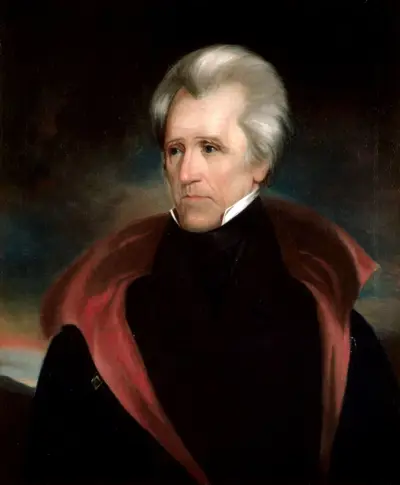
Andrew Jackson was an American lawyer, soldier, and statesman who served as the seventh president of the United States from 1829 to 1837. Before being elected to the presidency, Jackson gained fame as a general in the United States Army and served in both houses of the U.S. Congress. An expansionist president, Jackson sought to advance the rights of the "common man" against a "corrupt aristocracy" and to preserve the Union.
