Andrew Jackson Quotes
Polk's appointments all in all are the most damnable set that was ever made by any President since the government was organized.... He has a set of interested parasites around him, who flatter him until he does not know himself. He seems to be acting upon the principle of hanging an old friend for the purpose of making two new ones.... There is one thing I will say ... I never betrayed a friend or [was] guilty of the black sin of ingratitude. I fear Mr. Polk cannot say as much.
Andrew Jackson, 1767-1845, 7th President of the United States (Democrat, TN), Quoted in E. McKitrick, Andrew Jackson: A Profile
Sourced by: Eigen's Political and Historical Quotations

Upon learning that his son, John Quincy Adams, had been chosen President of the United States, the former President remarked:

2nd Viscount Melbourne. The pressure for appointments to key positions has always been a problem in modern America. What is surprising in this quotation is that the exact same problems existed in a constitutional monarchy in 19th century England. Note the formality of the form of address in letters to the Queen. Lamb refers to himself in the third person by his aristocratic title, “Lord Melboure”, rather than the first person “I” which would have been too familiar in the address of the monarch. Many English communications with the King or Queen, even in modern times, is this archaic form of address.


In most modern societies there is a combination of merit appointments and repayment of the rich. In the United States, wealthy people are often appointed as Ambassadors to countries of which they know little and often do not even speak the language. Assistant secretaries of cabinet level positions also often are awarded to the wealthy campaign contributors. Occasionally, these wealthy people have talent and do a good job. On most occasions where a person is appointed as the direct or indirect result of wealth, the person is mediocre or poor.
His role was the equivalent of the Mayor of Washington DC. This quotation is historically important as it shows is the norms for appointments in this era. The local party leaders essentially had the privilege of selecting an appointee provided he was reasonable qualified. Where not he did appoint a few Democrats.


The '44 referred to the 1844 election of James K. Polk as president.


The Mexicans had to agree to whatever terms the United States demanded. President Polk wanted to annex California and the New Mexico territory (included Arizona) as well as other territory including Baja—a territory much larger than Western Europe. Trist watered down the demand and only included California and the New Mexico territory.

2nd Baronet Peel. He was then the Chief Secretary of Ireland and only 26 years of age. Patronage jobs, cronyism, and corruption was then extreme in Irish politics.


Ford assumed the Presidency upon Nixon’s Watergate resignation. He was the only President in history who had never been elected to national office. When he pardoned Nixon he lost much of his support from the left and the middle. Weakened, he came under the influence of the very conservative wing of the Republican Party who urged him to dump his Vice President Nelson Rockefeller from the Republican ticket in the 1976 election. Rockefeller was a liberal republican who supported abortion rights and civil rights. Rockefeller, realizing that Ford’s nomination was in danger, volunteered to step down. {641394} Ford accepted and regretted his action as soon as he had done it. The result was that Ford lost to a relatively unknown Southern governor, Jimmy Carter. However the Conservative wing of the Republican Party had triumphed and the liberal republicans, who had been the backbone of the Republican Party since its inception did not play a significant role in the party for the next 30 years.

While that is certainly true and has been borne out by history, the same thing can be said of democratic rulers and even many democratic politicians of lower rank. Yes men abound and not politicians not only want them but arguably need them in order to maintain the assurance and positivity that most voters associate with good leadership.


The Republican controlled Senate whose Judiciary Committee and voted overwhelmingly for the President’s nominee for Attorney General, Loretta Lynch, but the Senate Republicans refused to the nomination up for a vote unless the Democrats and the President would agree to add an abortion ban on money that was to be appropriated for assistance to trafficked and sexually exploited women and girls. Never before had a nomination like this have been subject to this type of blackmail over terms of legislation on a matter that had nothing to do with the nominee or the cabinet position. However, this was the time one of the extreme periods of hyper partisanship in American History.

Although the Jacksonian Democrats were the political successors to the Jeffersonian Democratic Republicans, Jefferson found Jackson wanting as a potential president. Although Jefferson had made this statement during the 1824 Election, it did not become public until the Election of 1828 — Jackson’s second term. At that time Edward Coles, Formerly James Madison’s Secretary, disclosed the quotation.

He was reacting to President Donald Trump's demands of Personal Loyalty of his appointees. Trump was a businessman who ran provate (not public) corporations where it was not unusual for the owner to demand personal loyalty of all his key employees. He had not historical knowledge of experience with public service in America where, unlike campaigns, all officials take an oath of loalty to the Constitution and the nation and not to the President. Trump had fired the then FBI Director who was investigationg his campaign for illegal contacts with the Russians, which Trump regarded as an act of disloyalty, especially when the Director refused to pledge his loyalty to Trump.

In contrast to Trump, most political leaders engender loyality via their exemplary and admirable personal qualities and character and/or via a shared philosophy or ideology. Their loyalty tends to transcend proagmatics and the utility of the moment.


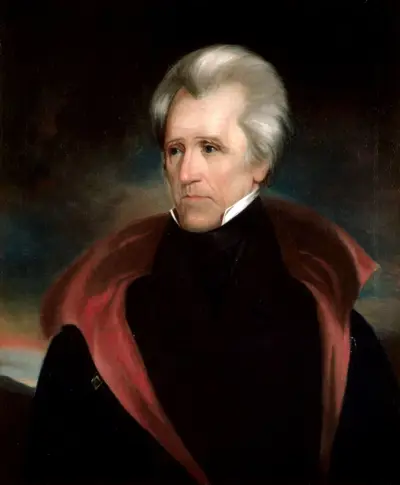
Andrew Jackson was an American lawyer, soldier, and statesman who served as the seventh president of the United States from 1829 to 1837. Before being elected to the presidency, Jackson gained fame as a general in the United States Army and served in both houses of the U.S. Congress. An expansionist president, Jackson sought to advance the rights of the "common man" against a "corrupt aristocracy" and to preserve the Union.
