Akilisi Pohiva Quotes
Our legislature is a farce. The representatives of the King outnumber the representatives of the people.
Tonga is the last of the Polynesian Kingdoms. The king is very powerful. Under his constitution, some legislators are elected and others are appointed by the king. The latter are in the majority so whatever legislation the king wants is passed and nothing is passed without his approval.
Akilisi Pohiva, Tongan Newspaper Editor & Elected Legislator, Interview, PBS National Geographic: The Monarchies, April 11, 2007
Sourced by: Eigen's Political and Historical Quotations


This Cahier was the consensus of the Clergy of Blois in 1789. There were cahiers of several provinces of France—some by the clergy, some by the nobles. What is fascinating is the emergence of many of the pre-revolutionary French concepts. The example of the American revolution and its principles was known throughout the educated classes of France.

In 1628 Parliament, in response to abuses by King Charles I, was about to pass The Petition of Rights–-a type of Bill of Rights. The King gave assurances that the practices—such as forcing nobles to lend him money—would not continue and didn't want to be embarrassed by passage of a law which he claimed would indicate that the Parliament did not trust him and weaken the dignity of the monarchy. The Petition of Rights passed with Cole’s leadership.


With a legislature of two houses, both have to agree to any change in order for it to take effect. This is always harder to do than to have change voted by a single legislative body.


Honore Gabriel Victor Requiti. The French King had just opened the French National Assembly which contained deputies (delegates) from the clergy, the nobility and the people. The King had made what some deputies thought was a very constructive and responsible speech opening the assembly. Mirabeau observed that as long as there was an absolute monarch in place, even a benign one. It was the presence of a monarch itself that was evil.


This was written shortly before he assumed the crown.


This was in effect a “Real Estate Promotional Document. Democracy, self government, and the right to set their own taxes were major selling points. See {611572} and {611571} for other “features.”

At the time most legislatures never had recorded votes but instead often depended on voice votes and other methods. Edison’s invention was a huge failure. Transparency was not a popular concept amongst politicians as it still is not, but some standards have changed.

The Congress and most of the State Legislatures are bicameral (two houses). Nebraska has only a unicameral (one house) legislature.


In most legislatures, the leader of the majority party can usually prevent any proposed legislation from coming to a vote. Many will use that individual power to block any legislation that they do not support. Others like Skelos believes that democracy requires that the entire legislature have the opportunity to vote on an issue and that a single individual or even a majority of the majority should not be able to block a vote as this would disenfranchise the legislators. In this case, the bill was to legalize Gay Marriage—a very controversial proposal. When the vote was taken, 4 Republicans and all but one Democrat voted in favor. The other Republicans and the one Democrat voted against. The bill passed and New York became the first large state to legalize Gay Marriage. Skelos, who opposed the bill, was castigated by conservatives of his own party for not using his power to prevent the vote from ever happening, and putting principle above party.


If a party controls one of the two houses of Congress, they can block any legislation. But governing involves passing legislation, and in our bi-cameral Congress, control of one house is not sufficient to pass legislation.
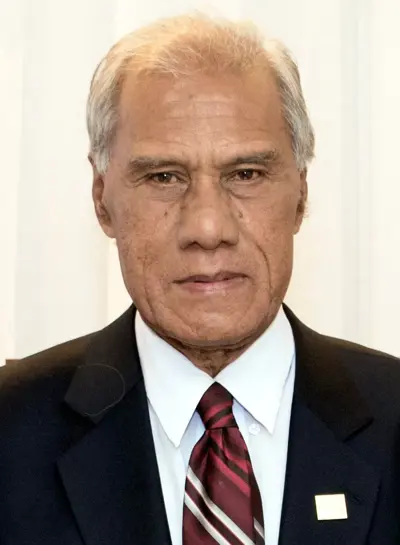
Samiuela ʻAkilisi Pōhiva was a Tongan pro-democracy activist and politician. Pohiva, the leader of the Democratic Party of the Friendly Islands (DPFI), served as the Prime Minister of Tonga from 2014 to his death in 2019. He was only the fourth commoner to serve as Prime Minister (after Shirley Baker in the 1880s, Siosateki Tonga in the 1890s and Feleti Sevele in the 2000s), and the first commoner to be elected to that position by Parliament rather than appointed by the King.
