Oliver Ellsworth Quotes
Legislatures have no right to set up an inquisition and examine into the private opinions of men.
Oliver Ellsworth, 1745-1807, Member of the Continental Congress, U.S. Senator (Federalist, CT), Chief Justice of the U.S. Supreme Court, U.S. Minister to France, Quoted in Philip B. Kurland and Ralph Lerner (eds.), The Founder's Constitution
Sourced by: Eigen's Political and Historical Quotations


Actually it was Thomas Jefferson who had drafted most of the language. This attack was aimed at President John Adams, the big supporter of the unpopular Alien and Sedition laws, and the man Jefferson was intent on unseating at the end of his first term. He did and destroyed the Federalist Party in the process.

Seeger had been a member of the Communist Party and had left it in 1950. See {635866}. He was later called before the House UnAmerican Activities Committee and asked to reveal the names of others who had been members. In those days of the red scare and McCarthyism, most people asked to name names and not wanting to do so “took the 5th Amendment” and could not be legally forced to reveal the names. Seeger as a matter of principle refused to plead the 5th Amendment because he was not afraid of incriminating himself and had done nothing criminal anyway. So he, a war veteran of WWII, instead refused to answer citing his First Amendment right of freedom of association. There was no legal precedent for this, and he was indicted and convicted for Contempt of Congress. However, his conviction was overturned as unconstitutional by the U. S. Federal Appeals court. Seeger had prevailed legally. But in retaliation Seeger was blacklisted and none of the radio of TV networks or Hollywood Studios would allow him (and other blacklisted artists) to appear. See {642545} Today most Americans view what McCarthy, The Congressional Committee, the networks, and Hollywood studios had done as contemptible.


In a celebrated case involving the right of the U. S. House of Representatives' Un-American Activities Committee to "expose" someone as a Communist, Mr. Justice Brennan wrote:


For the classic formulation, see Brandeis, Olmstead v. U.S., 1927


In WWI Congress had passed a law that prohibited anyone from undermining or interfering with the war effort. The defendants had passed out anti-war literature to young men heading for military service. The court then overlooked the First Amendment and came up with a strange logic where the “clear and present danger” was the test of whether the First Amendment would apply. The anti war pamphleteers went to jail. Today, we look back on this and find it very surprising but this is yet another example of erosion of freedom and civil liberties when the nation is at war. By the 1950s, the Supreme Court had reversed itself and the First Amendment was restored to its original intent.


What was to become the 14th Amendment was being discussed. Several of the most radical Republicans drafted language that would allow Congress to make any law regarding life, liberty or property, so that they could be sure that the States would not make their laws in a discriminatory manner. However, Hotchkiss and the majority wanted to be sure the laws were not discriminatory but they didn’t want Congress to have the power to make any law regarding life, liberty and property for every state. The current version of the 14th Amendment just prohibited discrimination in laws, not empowering the Federal Government to override the state governments in most important areas.


He was the Chairman of the Senate Judiciary Committee. The intelligence and law enforcement advocates of reducing privacy rights so that law enforcement can prevent acts of terrorism frame the question as a tradeoff between civil right and safety. However, as Leahy and many others point out, we would not be much safer if we gave up all our ivil rights. Further, hundreds of thousands of American have given their lives so that we would have those civil rights. Without them what are we protecting.

He, in a speech to Parliament, had criticized the Iranian Judiciary on several counts, He was then reprimanded for doing so.
Seeger had been a member of the Communist Party and had left it in 1950. See {635866}. He was later called before the House UnAmerican Activities Committee and asked to reveal the names of others who had been members. In those days of the red scare and McCarthyism, most people asked to name names and not wanting to do so “took the 5th Amendment” and could not be legally forced to reveal the names. Seeger as a matter of principle refused to plead the 5th Amendment because he was not afraid of incriminating himself and had done nothing criminal anyway. So he, a war veteran of WWII, instead refused to answer {635867} citing his First Amendment right of freedom of association. There was no legal precedent for this, and he was indicted and convicted for Contempt of Congress. However, his conviction was overturned as unconstitutional by the U. S. Federal Appeals court. Seeger had prevailed legally. But in retaliation Seeger was blacklisted and none of the radio of TV networks or Hollywood Studios would allow him (and other blacklisted artists) to appear. Today most Americans view what McCarthy, The Congressional Committee, the networks, and Hollywood studios had done as contemptible.


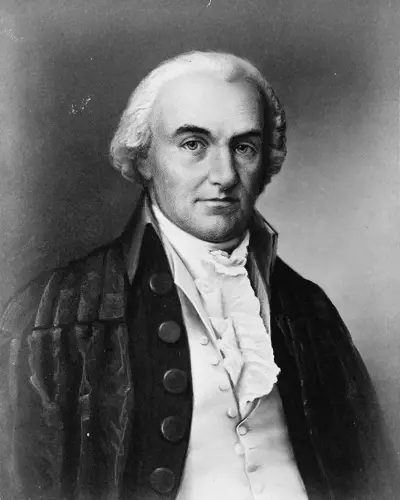
Oliver Ellsworth was an American lawyer, judge, politician, and diplomat. He was a framer of the United States Constitution, a United States Senator from Connecticut, and the third Chief Justice of the United States. Additionally, Ellsworth received 11 electoral votes in the 1796 presidential election.
