William J. Brennan Jr. Quotes
An investigation in which the processes of law-making and law-evaluating are submerged entirely in exposure of individual behavior—in adjudication, of a sort, through the exposure process—is outside the constitutional pale of congressional inquiry.
In a celebrated case involving the right of the U. S. House of Representatives' Un-American Activities Committee to "expose" someone as a Communist, Mr. Justice Brennan wrote:
William J. Brennan, Jr., 1906-1997, U. S. Supreme Court Justice, Dissenting Opinion, Barenblatt v. United States, 1958
Sourced by: Eigen's Political and Historical Quotations


This is the justification of virtually all legislatures that exempt their members from general requirements of law or grant them special privileges. Occasionally, the justification is warranted; most often, not.


Americans had never had the opportunity to see this committee in action before. While many Americans were intimidated, many were also very distressed to see how a Congressional Committee was abusing its power. And although the frightened Hollywood and network executive executives were intimidated into blacklisting Lawson and others, more and more Americans were lining up against this committee and Senator McCarthy’s committee in the Senate. This culminated in the Senate sanction of McCarthy and the discrediting of HUAC which never again had the influence that they had before this hearing.
Responding to suggestions that drug traffickers be summarily executed:


And let the sheriffs who have arrested them bring them before the justice without any other summons.
This assize is generally considered to be the first written specification of due process in English Common Law.

This constitution was written 7 years before the national constitutional convention. It shows that there was concern about the separation of powers in United States even before the Constitution was drafted. See {616749} for an even clearer statement of the separation of powers principle. The national legislatures in Europe had commonly declared people traitors and in many cases incarcerated or executed them. This clause, effectively presaged the national constitution of 1787 where the Congress was prohibited from trying people for treason or anything else except impearchment.
See Montesquieu {607909} for an earlier, similar view.

Johnson, fundamentally an inveterate racist, tried to kill all attempts at protecting Negro rights after the Civil War. Congress rewrote the Bill to obtain enough signatures and then passed it over the President’s Veto later in the year.


He, in a speech to Parliament, had criticized the Iranian Judiciary on several counts, He was then reprimanded for doing so.


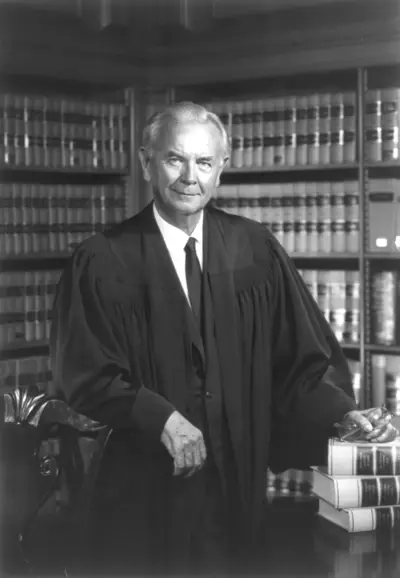
William Joseph Brennan Jr. was an American lawyer and jurist who served as an Associate Justice of the United States Supreme Court from 1956 to 1990. He was the seventh-longest-serving justice in Supreme Court history, and known for being a leader of the Court's liberal wing.
