Alexander Hamilton Quotes
Men will pursue their interest. It is as easy to change human nature as to oppose the strong current of selfish passions. A wise legislature will gently divert the channel, and direct it, if possible, to the public good.
Alexander Hamilton, 1755-1804, Aide-de-camp to General Washington, Member of the Continental Congress and the Constitutional Convention, U. S. Secretary of the Treasury (Federalist, NY), Speech, New York ratifying convention
Sourced by: Eigen's Political and Historical Quotations


George Washington, 1732-1799, 1st President of the United States (VA), in a consolation statement to John Laurens who had reported failure getting the Continental Congress to accept one of Washington’s proposals. See related quotes.

This clause was a throwback to the days before the separation of powers where the legislature could imprison anyone they thought contemptuous or interfering with their deliberation. Contrast this with the earlier constitution of Massachusetts which forbade the legislature from acting as a judge or prosecutor. See {616750} and {616749}. Also this was a clear invasion of freedom of the press and freedom of speech provided by the Bill of Rights. However, at the time, it was not clear that the Federal Constitution was binding on State Governments on State Matters. Modern law is still ambiguous on this general point, but not on freedom of speech and the press which is currently definitely binding on the states.
There was sufficient concern about possible corruption or the tyranny of the majority that this provision was written into the first Ohio Constitution of 1802.


There are many methods of voting in a legislative body. “Viva Voce” is Latin for “by Voice” and is often called a “Voice Vote”. Voting by ballot takes longer but had the advantage or disadvantage of secrecy. The theory was that if the New York Legislators could vote in a secret ballot, the lobbies and special interests would not be as influential since they would never know for sure—unless there were a unanimous vote—how any particular legislator voted. A further advantage is that Party Discipline could not be imposed and parties or “factions” as they were then called would be less powerful—a great concern of all the patriots who tended to distrust parties. The disadvantage was that the people who elected the legislator would never know how he voted. Note the frank admission that this was an “experiment”. Americans of the era realized that almost everything they were doing was a political experiment and this introduced a pragmatic force into structure and procedures of American politics.


In most legislatures, the leader of the majority party can usually prevent any proposed legislation from coming to a vote. Many will use that individual power to block any legislation that they do not support. Others like Skelos believes that democracy requires that the entire legislature have the opportunity to vote on an issue and that a single individual or even a majority of the majority should not be able to block a vote as this would disenfranchise the legislators. In this case, the bill was to legalize Gay Marriage—a very controversial proposal. When the vote was taken, 4 Republicans and all but one Democrat voted in favor. The other Republicans and the one Democrat voted against. The bill passed and New York became the first large state to legalize Gay Marriage. Skelos, who opposed the bill, was castigated by conservatives of his own party for not using his power to prevent the vote from ever happening, and putting principle above party.

With a legislature of two houses, both have to agree to any change in order for it to take effect. This is always harder to do than to have change voted by a single legislative body.

Many people think that this is still a problem with economics. There is a new branch of economics—behavioral economics—which focuses on human economic actual behavior as opposed to theoretical behavior.


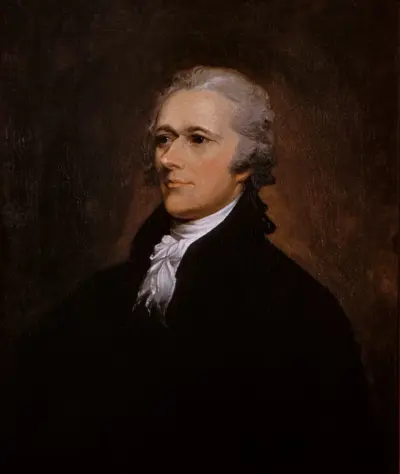
Alexander Hamilton was an American statesman, politician, legal scholar, military commander, lawyer, banker, and economist. He was one of the Founding Fathers of the United States. He was an influential interpreter and promoter of the U.S. Constitution, as well as the founder of the nation's financial system, the Federalist Party, the United States Coast Guard, and the New York Post newspaper. As the first secretary of the treasury, Hamilton was the main author of the economic policies of George Washington's administration. He took the lead in the federal government's funding of the states' debts, as well as establishing the nation's first two de facto central banks, the Bank of North America and the First Bank of the United States, a system of tariffs, and friendly trade relations with Britain. His vision included a strong central government led by a vigorous executive branch, a strong commercial economy, government-controlled banks, support for manufacturing, and a strong military.
