Andrew Jackson Quotes
Our Constitution does not contain the absurdity of giving power to make laws and another to resist them.... The Father of His Country [George Washington] did not affix his revered name to so palpable an absurdity. Nor did the states, when they severally ratified it, do so under the impression that a veto on the laws of the United States was reserved to them or that they could exercise it by implication.
In response to South Carolina's nullification of the Tariff Act of 1832, President Jackson proclaimed:
Andrew Jackson, 1767-1845, 7th President of the United States (Democrat, TN), Proclamation to the People of South Carolina, December 10, 1832
Sourced by: Eigen's Political and Historical Quotations

The 10th Amendment was created to take care of this objection which Jefferson and many others had.


Soon after Jackson's reelection, delegates from South Carolina, led by John C. Calhoun, moved quickly to declare "null, void, and no law" the Tariff Act of 1832. The president's reaction to the Ordinance of Nullification was swift.


Jackson was reacting to the claimed right of South Carolina to nullify Federal tariffs and other Federal laws.

On June 12, 1789 a Senate committee proposed a federal court system for the nation. Maclay described it as:


South Carolina did not like the protectionist measures that Congress had passed. Although the Federal Government clearly had the Constitutional authority to regulate interstate and international commerce, South Carolina, led by John C. Calhoun, took the position that any state could nullify a Federal law’s application within their state. Clearly, that was a vision of a nation that would have very different from our history where the Federal Courts were the only institution that could nullify an act of Congress anywhere.


This is a classic type of fallacious political logic. The author claims that there are no powers in the constitution to make laws in a number of important areas of our society. What is true, is that there is no explicitly and uniquely specified statements in the Constitution regarding the areas he specified (and some he didn’t like education). However the power to make laws in these areas comes from the “Commerce Clause” where the Federal Government was given the power to regulate Interstate Commerce. And that is what the Federal Government does make laws about. Food that is sold in the state where it is grown is regulated by the states. But interstate agriculture is. Medicines and weapons are also sold and transported in interstate commerce. Even housing is in part covered as financing and mortgages, building materials, working conditions of the building companies are part of Interstate Commerce. A succession of Congresses have recognized this and so has every Supreme Court in our history. McManus however believes that all these legislators and judges have been wrong and worse, part of a conspiracy to subvert the Constitution. See {630683} for his tendency to see conspiracies in politics.


Indeed, the control is only one the medium term when after 4 years a President can be replaced by the voters. But a number of President’s have embarked upon foreign policies that was opposed by the majority of the population.


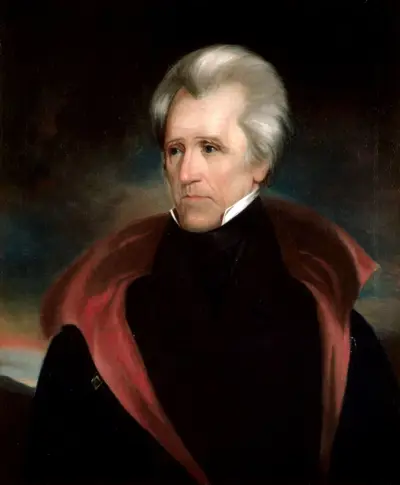
Andrew Jackson was an American lawyer, soldier, and statesman who served as the seventh president of the United States from 1829 to 1837. Before being elected to the presidency, Jackson gained fame as a general in the United States Army and served in both houses of the U.S. Congress. An expansionist president, Jackson sought to advance the rights of the "common man" against a "corrupt aristocracy" and to preserve the Union.
