Andrew Jackson Quotes
This right to secede is deduced from the nature of the Constitution, which they say is a compact between sovereign States who have preserved their whole sovereignty, and therefore are subject to no superior; that because they made the compact, they can break it when in their opinion it has been departed from by the other States. Fallacious as this course of reasoning is, it enlists State pride, and finds advocates in the honest prejudices of those who have not studied the nature of our government sufficiently to see the radical error on which it rests.
Andrew Jackson, 1767-1845, 7th President of the United States (Democrat, TN), Proclamation Regarding Nullification, December 10, 1832
Sourced by: Eigen's Political and Historical Quotations

Jackson makes the case against the South Carolina argument for nullification. In the related quote, he makes his threat which was very successful in ending the notion of “nullification”. The extensive quotation is given as it summarizes the entire issue that was one of the crises of early America.
In the related quote, Jackson makes the case against the South Carolina argument for nullification. Here he makes his threat which was very successful in ending the notion of “nullification”. The extensive quotation is given as it summarizes the entire issue that was one of the crises of early America.
Soon after Jackson's reelection, delegates from South Carolina, led by John C. Calhoun, moved quickly to declare "null, void, and no law" the Tariff Act of 1832. The president's reaction to the Ordinance of Nullification was swift.


Commonly referred to as the Kentucky Resolution. This concept of Nullification was one of the factors that aggravated the tensions leading to the Civil War. Were the individual States to be the arbiters of whether or not a Federal act was Constitutional or was it to be the Supreme Court.

Jackson was reacting to the claimed right of South Carolina to nullify Federal tariffs and other Federal laws.


This is an important quotation because it shows that slavery was the principle reason that the South succeeded and began their rebellion. In the early 20th century, there was a movement to make the Confederacy and the Southern rebellion more noble by promoting the idea that the Civil War was fought by the South for more lofty reasons than greed and slavery such as States Rights, original construction, different economic philosophies and the like. This was a more noble cause then the right to deny other human beings their rights, to own other human beings who they could beat, torture, sexually use and even murder them was a pretty selfish and demeaning reason to have started a rebellion that would then cost more Americans their lives than any other American conflict. The succession documents and others of the Southern States and the Confederacy make it clear that slavery was THE issue and fleeting references to any of the others were only made to complain about the potential effect on abolition and the refusal of the abolitionist states to cease aiding and protecting fugitive slaves.


At the time his Vice President, John C. Calhoun, was expounding a theory of “nullification” by which the states could supersede and nullify federal law in their states. When Jackson finished his toast, it was Calhoun’s turn (See {635896}.) His toast supported the States’ Rights position over the federal government. In those days Presidents and Vice President’s were often political enemies or of opposite parties. The President’s advisors thought that his toast might be misinterpreted. So when they gave the toast to the press as “The Federal Union: It must be preserved.” That was the form in which the press reported the President’s toast and for many years that was the version most quoted even though it was never delivered that way. However Jackson was responsible for both versions.


In response to South Carolina's nullification of the Tariff Act of 1832, President Jackson proclaimed:
The words are those of President Andrew Jackson. See {604550}. After occupying New Orleans, General Butler infuriated the Confederate Sympathizers with this act. Jackson was the hero of the Battle of New Orleans and an unapologetic slave owner. The Southerners had erected a magnificent statue of their hero Jackson on horseback in a major section of the city. Butler, then ordered that the Jackson quotation be chiseled in the stone base. The townspeople were furious that this Union General would make up words and attribute them to Jackson; however, when they finally realized that Jackson had actually said those words they felt even more humiliated. There are still a few Southernors who consider this terrible insult to the Confederacy, and of course that is just what Butler intended.
When the 13 states were united only by the loose bonds of the Confederation, Jefferson wrote:
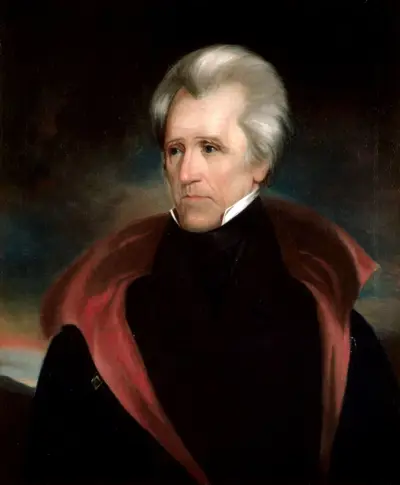
Andrew Jackson was an American lawyer, soldier, and statesman who served as the seventh president of the United States from 1829 to 1837. Before being elected to the presidency, Jackson gained fame as a general in the United States Army and served in both houses of the U.S. Congress. An expansionist president, Jackson sought to advance the rights of the "common man" against a "corrupt aristocracy" and to preserve the Union.
