Alcuin Quotes
Nor should we listen to those who say "The voice of the people is the voice of God," for the turbulence of the mob is always close to insanity.
This quotation is almost always given as if it were Alcuin who advocated listening to the people, when actually his view was just the opposite. See William Tecumseh Sherman for a more modern expression of the same view. Also, Walter Reynolds {32317} for an opposite view, but using a similar phrase. Note that since he was referring to what "the people" say, the quote must have been in common usage in the 9th century. For the earliest known use of the statement in Western civilization, see Hesiod {603399}.
Alcuin [Flaccus] of York, ~735-804, English Scholar & Abbot, Letter to Emperor Charlemagne, 800
Sourced by: Eigen's Political and Historical Quotations

See Walter Reynolds {32317} for a later English version. Also, Alcuin of York {593018} and William Tecumseh Sherman for an opposite view using a similar phrase. Hesiod's seems to be the earliest version of this idea that is with us today.

The Latin means “the voice of the people is the voice of God.” See Alcuin if York {593018} for a quick history of the statement. Essentially, in science public opinion is irrelevant or at least should be. One of the major political issues in our society is whether ideology and/or public opinion should control policy and practice of scientific issues, methods, and practices.


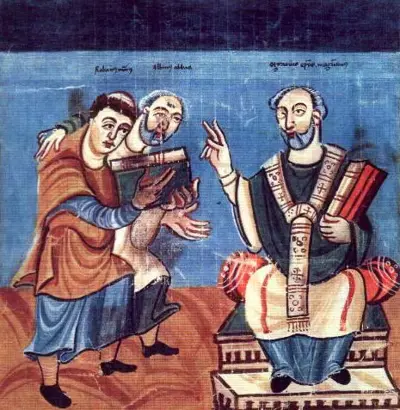
Alcuin of York – also called Ealhwine, Alhwin, or Alchoin – was an English scholar, clergyman, poet, and teacher from York, Northumbria. He was born around 735 and became the student of Archbishop Ecgbert at York. At the invitation of Charlemagne, he became a leading scholar and teacher at the Carolingian court, where he remained a figure in the 780s and 790s. "The most learned man anywhere to be found", according to Einhard's Life of Charlemagne (c. 817–833), he is considered among the most important intellectual architects of the Carolingian Renaissance. Among his pupils were many of the dominant intellectuals of the Carolingian era.
