Ginni Rometty Quotes
No negro, mulatto, or Indian whatsoever ... shall hereafter presume to keep, or carry any gun, powder, shot, or any club, or other weapon whatsoever, offensive or defensive.
This gun control was not even the first in the nation. See {613055}. However it even applied to free Negroes, halfbreeds, as well as slaves. Five years later even though Virginia needed militia for the French and Indian Wars they passed a law barring even Free Blacks from serving in the Militia except “as drummers or trumpeters.” This the whites felt was critical in that most whites did not own firearms. See {613056}.
Virginia, An Act for the better government of Negroes, Mulattoes, and Indians, 1723
Sourced by: Eigen's Political and Historical Quotations

This is historically a very important quotation. It shows that gun control was existant in Colonial America. The violation of the gun laws were so serious that the Connecticut Council itself heard and tried the case and it was not even handled by the constable. On the same day, they also fined Bartholomew Barnardt for allowing his son to shoot a militia musket in his possession. Today, most states would not be allowed much gun control as politically there is a belief that in Colonial America gun use and ownership was almost universal. That assertion appears to be untrue. See {613056} and {613057}.

Washington was very unhappy with militia even from his native Virginia. See also {613030} This quotation is very important because the common belief is that all Americans in Colonial America were skilled with a gun and that there was a strong gun ownership culture. Many people quote {613057}. However, that was not the case as this and other research has shown. Less than one quarter of the Virginia militia had any weapon. Guns were expensive and only a minority of Americans could afford them. Despite the image of sharpshooters, and there were some, most guns were very inaccurate in the hands of most men.


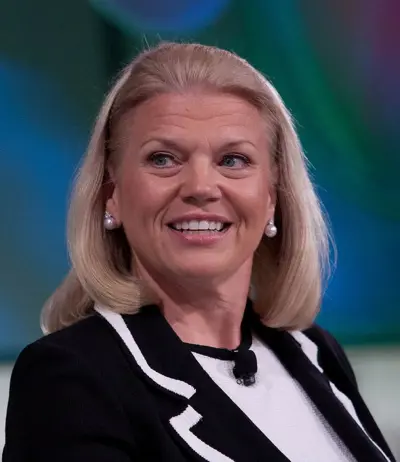
Virginia Marie "Ginni" Rometty is an American business executive who served as executive chairman of IBM after stepping down as CEO on April 1, 2020. She previously served as chairman, president and CEO of IBM, becoming the first woman to head the company. She retired from IBM on December 31, 2020 after a near-40 year career at IBM. Prior to becoming president and CEO in January 2012, she first joined IBM as a systems engineer in 1981 and subsequently headed global sales, marketing, and strategy. While general manager of IBM's global services division, in 2002 she helped negotiate IBM's purchase of PricewaterhouseCoopers' IT consulting business, becoming known for her work integrating the two companies. As CEO, she focused IBM on analytics, cloud computing, and cognitive computing systems.
