Calvin Coolidge Quotes
No complicated scheme of relief, no plan for government fixing of prices, no resort to the Public Treasury will be of any value …
All the objections that Coolidge had in his veto message, were not convincing to modern Presidents and members of Congress as well as well the American people. Our Agricultural policy has had all these elements for years now.
Calvin Coolidge, 1872-1933, 30th President of the United States (Republican, MA), Speech when vetoing farm relief legislation
Sourced by: Eigen's Political and Historical Quotations


There was a financial crisis in the country and the world when highly risky home mortgage loans defaulted leaving investors and speculators in mortgage-backed securities in a poor position. The investors had been reaping very high interest rates for their risky investments, but this was the first time that this form of risky investment had failed. The investors, of course were looking for a bailout from government. When the Bush administration failed to bail out investment bank, Lehman, there was a panic and the banking system of the country and much of the world froze up. Bush and his Secretary reversed their bailout of speculators policy and provided various assistants and bailouts to the very bankers and other investors who had caused the economic meltdown. The policy was continued by the Obama administration although the bailouts were just as distasteful to Obama as they were to Bush, but most economists agree that the two presidents very distasteful and unpopular bailout actions probably saved the nation from a massive depression. After being bailed out by the taxpayers, the Bankers then paid themselves exorbitant bonuses while the results of their management put 10 percent of the country out of work.


Hoover was the Food Administrator at that time. Although he gave lip service to the free market economy concept, he was proposing government price controls and rationing. When the free market was not functioning, at this time in his career, he was willing to use government controls and regulation. By the end of 1918 over 250,000 food-handling corporations, firms, and individuals were under Food Administration licenses. Meat, fish, poultry, eggs, butter, milk, potatoes, fresh and dried vegetables, and fruits, canned goods, the coarse grains and rice, vegetable oils, coffee, and such various commodities accessory to food-handling, as ice, ammonia (for ice-making), arsenic (for insecticides), jute bags, sisal, etc., were under direct control. Ironically, later when he was President and faced with the Great Depression, he had become much more rigid and would not “interfere” with the free, private market and use government to solve the national problems. It was Franklin Delano Roosevelt who did that after Hoover would not. At the time he gave this speech, Hoover was not very political and was more of a technocrat. It may have been that by the time he became President he was intellectually and politically locked in to Republican Party conservative economic ideology.

Chrysler had gotten into cash flow difficulty and could not borrow enough money to keep open until they could pay their bills. Their credit was not good enough for most lenders. Iacocca approached the Federal Government and asked for a Federal loan guarantee of about $1 billion. Some members of Congress and public critics were outraged that a private company might get a Government bail out in the form of a loan guarantee. Extremists of both parties did not want to set such a precedent of using Federal money to assist private corporations. Iacocca was quite defensive about asking for what seemed to be a precedent setting request. However, he then found out that it would set no precedent at all. Chrysler got the loan, paid all its creditors, paid back the loan with interest, and the company did not go under, but did well for a while.


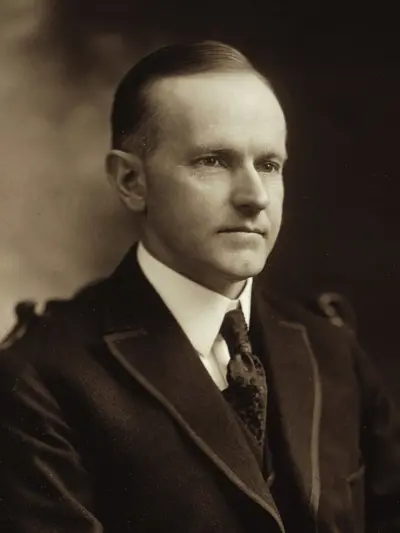
Calvin Coolidge was an American lawyer and politician who served as the 30th president of the United States from 1923 to 1929. A Republican lawyer from New England, born in Vermont, Coolidge worked his way up the ladder of Massachusetts state politics, eventually becoming governor of Massachusetts. His response to the Boston Police Strike of 1919 thrust him into the national spotlight and gave him a reputation as a man of decisive action. The next year, he was elected the 29th vice president of the United States, and he succeeded to the presidency upon the sudden death of Warren G. Harding in 1923. Elected in his own right in 1924, he gained a reputation as a small-government conservative and also as a man who said very little and had a rather dry sense of humor.
