Council of Westminster Quotes
Let no man, for the future, presume to carry on the wicked trade of selling men in markets, like brute beasts, which hitherto hath been the common custom of England.
This was one of the first steps to ending of slavery in England. The council passed a number of general reforms from this to the prohibition of the clergy frequenting ale houses.
Council of Westminster, St. Peter's, 1102
Sourced by: Eigen's Political and Historical Quotations

In the Jim Crow era and well into the 20th century, many school books and historians, wanting to minimize the enmity between North and South, tended to a historical revisionism where the real brutal and immoral edge of slavery was minimized and slave owners were depicted as being in error by modern standards but well-meaning and paternalistic. Foner, with this famous quotation, put the lie to the false image of paternalistic slavery. By the beginning of the 21st century, there were very few serious historians who still tried to characterize slavery in the South as “paternalistic” otherwise humane. See {584014} for another of Foner’s famous quotes regarding slavery

He was also himself a ship owner in the slave trade and he was the brother of the leading Rhode Island abolitionist, Moses Brown. See {585793}. Brown became the first American, prosecuted in federal court for illegal slave trading –-- a prosecution brought, in part, by his own brother. He was, however, acquitted.


The Brown family were very wealthy. John was involved in many speculative enterprises, owned slaves, and had been in the slave trade, and then it had been outlawed in large part by the efforts of his brother, Moses Brown who was a staunch abolitionist and an officer of the Rhode Island Abolition Society. The quotation is important because one theory is that the only reason that the slave trade became illegal was because it was not very profitable due to the high cost and loss ratio and the competition from slaves who were born of slave mothers. So the slave trade was outlawed but not slavery which was so profitable. However, this quotation illustrates how profitable the slave trade was and the early legislation was therefore motivated by ethical and moral concerns.


The British Consul was attempting to implement the British government’s new anti-slavery policy.


Southern secession and the Civil War This is one of the major quotations with which historians rebut the revisionist view that the Civil War was about States’ Rights or other economic factors.


One of the first anti-slavery formal resolutions in America.

Brown was the richest man in Rhode Island and made much of his money in the slave trade. This quotation shows that slavery was not completely a North verses South split. Northerners like Brown for whose family Brown University was named, was as virulent supporter of slavery as the most ardent Southerner.
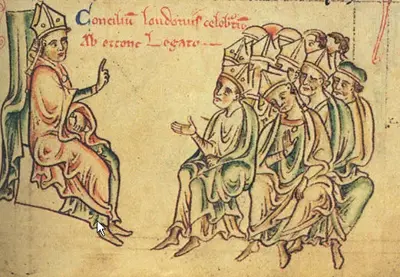
Synods of Westminster were certain of the more important ecclesiastical councils held within the present bounds of London. Though the precise locality is occasionally uncertain, the majority of the medieval synods assembled in the chapter-house of old St Pauls, or the former chapel of St Catherine within the precincts of Westminster Abbey or at Lambeth. The councils were of various types, each with a constitutional history of its own. Before the reign of Edward I, when convocation assumed substantially its present form, there were convened in London various diocesan, provincial, national and legatine synods; during the past six centuries, however, the chief ecclesiastical assemblies held there have been convocations of the province of Canterbury.
