Rupert Quotes
Lest the masters and scholars of our institution of Heidelberg may be oppressed by the citizens, avarice inducing them, through the extortionate price of lodgings, we have seen fit to decree that henceforth each year, after Christmas, one expert from the university on the part of the scholars, and one prudent, pious and circumspect citizen on the part of the citizens, shall be deputed to fix on the price for the students' lodgings. Moreover we will and decree that the different masters and scholars shall, through our bailiff, our judge and the officials subject to us, be defended and maintained in the quiet possession of the lodgings given to them free or of those for which they pay rent
Just as there are university towns where the students and faculty are taken advantage of, so it was in Medieval Germany. The Prince established the university in the mode of the University of Paris, and in this passage has one of the earliest examples of rent control, complete with a commission to set the prices.
Rupert, 1619–1682, German Prince, Count Palatine of the Rhine, & Duke of Bavaria,, Decree Founding the University of Heidelberg, 1386
Sourced by: Eigen's Political and Historical Quotations


Brandeis was U. S. Supreme Court Justice Louis D. Brandeis, 1856-1941, who wrote that competition would control prices if only healthy competition could be maintained—the problem was resolved by both increasing competition and much more stringent regulation of corporations.

Manava Dharma Shastra. Ancient Hindu India had what may well have been the most regulated mercantile economy of any society in history. All prices for all goods were to be set by the king. In order to prevent the stultifying effect of price controls, the Hindus required that the prices be reset very frequently to reflect various market conditions. It was a highly regulated form of capitalism. This text is a part of the Hindu Holy Texts. Hindus believe that Manu was a prophet whose text is revealed or inspired.


Collection of Spoken Words of the Prophet. Ironically, despite the reverence with which words of the Hadith are accorded in Islam, from time to time Muslim theologians and authorities have attempted to establish “fair prices” despite this free market view of the Prophet.

These appear to be the first economic regulations of New England. Note that although there was a Governor of the Colony, such economic issues were considered to be fundamentally religious in nature. Therefore Cotton—the leading cleric of the colony—was called upon to in effect legislate on the subject. Ironically, this is not terribly different from the theocracy in Iran or some other Muslim countries of today where like some of the early American Colonies, there was no separation of church and state.

“Familia” in Latin meant in this context, the community or the citizens as opposed to the officials, The Bishop determined the former was under attack by the officials who in the probating of wills and estates would take bribes or levy taxes under “laws” that they would make up on the spot bilking the rightful inheritors of the property and wealth of the deceased. The principle that laws and regulations must be written down in advance and not otherwise, is a fundamental part of Western law today, But as this quotation shows, it was not always such.

Hoover was the Food Administrator at that time. Although he gave lip service to the free market economy concept, he was proposing government price controls and rationing. When the free market was not functioning, at this time in his career, he was willing to use government controls and regulation. By the end of 1918 over 250,000 food-handling corporations, firms, and individuals were under Food Administration licenses. Meat, fish, poultry, eggs, butter, milk, potatoes, fresh and dried vegetables, and fruits, canned goods, the coarse grains and rice, vegetable oils, coffee, and such various commodities accessory to food-handling, as ice, ammonia (for ice-making), arsenic (for insecticides), jute bags, sisal, etc., were under direct control. Ironically, later when he was President and faced with the Great Depression, he had become much more rigid and would not “interfere” with the free, private market and use government to solve the national problems. It was Franklin Delano Roosevelt who did that after Hoover would not. At the time he gave this speech, Hoover was not very political and was more of a technocrat. It may have been that by the time he became President he was intellectually and politically locked in to Republican Party conservative economic ideology.

Whenever price controls have been tried, there always seems to develop a black market. However, some argue that price controls can work very well for a modest period of time in a national emergency and give WWII as an example. Although there was a black market, very few Americans participated in it, and the effect was positive as a result of the patriotism that was so keenly felt by most Americans at that time. Further, capital punishment has rarely worked to prevent any illegal activity. In London, pickpockets were publicly hung while other pickpockets fleeced the crowd watching the hanging ostensibly to dissuade people from pickpocketing.


See linked quotes for a counterpoint.


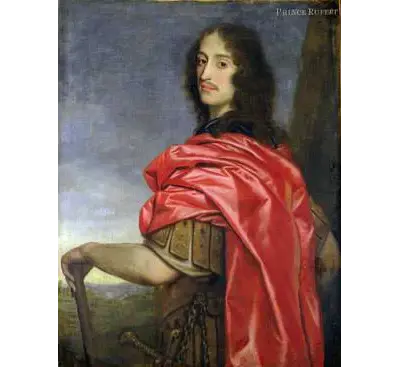
Prince Rupert of the Rhine, Duke of Cumberland, KG, PC, FRS was a German-English army officer, admiral, scientist and colonial governor. He first came to prominence as a Royalist cavalry commander during the English Civil War. Rupert was the third son of the German prince Frederick V of the Palatinate and Elizabeth, eldest daughter of James VI of Scotland and I of England.
