Oliver Stone Quotes
Latin American leaders have been demonized by a combination of their own local media—which is controlled by private, rich families who don’t want to see change in their countries—and also the U. S. media which is surprising considering the distance from the facts.
Oliver Stone, Film director, screenwriter, and producer, Interview, The Progressive, September 2010
Sourced by: Eigen's Political and Historical Quotations


At the time, there were few who saw the significance and many dismissed it as left wing intellectual paranoia. By the end it the 29th century it was the right wing which carried this mantra.

_0_thumbnail_47x47.jpg)
Ironically politicians need the journalists to communicate their message adn get public exposure and the Journalists need the politicians to provide subject matter and to serve as sources. Each uses the other which produces resentment.


The queen was a lot more sophisticated about the newspapers than politicians in the 21st century.

Until the 20th century almost all American political media were shamelessly and overtly biased—left or right. Political Parties had their own de facto publications much like Fox News became for the Republicans in the 21st century. In the 20th century journalism developed into a profession that evolved standards of objectivity in reporting. That norm then prevailed for about 70 years. With the extreme polarization of the later years of the 29th Century the right wing began to accuse much of the media of a left wing bias, and the media tended to react as Krugman describes in this quotation. The model of having spokespersons for “each side” of an issue works for highly subjective political preferences with a two party system, but where it broke down is with scientific and technical issues. On these, there often really are not two scientific points of view, but there is a scientific consensus of the vast majority of scientists and almost all the prestigious and accomplished scientists are in accord. However, there may be some who have a cultural, religious and/or political concern for some science and its implications for society. They in turn find a scientist or two, often one who is unaccomplished and not recognized in the scientific field to argue a different point of view. The media have tended to equate the two and have a “debate” as if there were two sides to the science when there are not. These issues tend to cluster around scientific medical issues involving sex and birth control methods, environment and conservation, evolution, the age of the earth and the method of creation of the universe. The problem is particularly exacerbated by the general scientific illiteracy of the American population and the relatively few journalists who themselves are scientifically literate who can explain scientific issues well.


This quotation is extremely subtle. Vidal tells us that he has always hated organized labor. He also tells us that the media has always given us one monolithic view of organized labor. He is silent as to whether that view was accurate and justified or in his mind or whether he was just going along with the image created by the media. There is no answer, but it is a quotation that is food for thought. Numerous studies found that at the beginning of the 21st century, the public view of labor union crooked and/or communist leaders was much worse than reality.

She has been both the most popular and the most criticized first lady in American History. She was the first lady for a longer period than any other as her husband was elected to 4 terms. Since he was crippled by polio and could not easily travel, she represented him and the nation at more events than any other First Lady. She was also very outspoken who areed with FDR on most issues but publicly differed on occasions. Further, she wrote more than any other First Lady, including a daily newspaper column, My Day, which appeared in many newspapers each day. This quotation came from one of her thousands of articles.


The Netherlands at that time had a representative republic, but whenever there were troubles, there were many who urged the appointment of a strongman—usually a prince or other noble. In the Dutch republic at the time, de Witt was the Chief Executive, but under their constitution, he could do little without the approval of the parliament. A strong leader with dictatorial powers was called for as there was little experience with a democratic republic and people did not have confidence that governance in a crisis was possible without dictatorial powers lodged in one man. Even in America, there tends to be more power taken by the presidency in time of war and other crises. So the fear and the argument has not changed in almost 400 years.

Prior to Germany Declaring War on the United States, there was a small but influential group of American Fascists who were great admirers of Hitler and Mussolini and the “reforms” they had made in Germany and Italy. They saw Germany’s invasion of other European nations as a good think to “reform” Europe. The opposed American support of England and U. S. entry into the war. Their influence waned after Pearl Harbor and Germany declaring war on the U. S. Many of them arose again after WWII ended but they no longer expressed admiration for Hitler and Mussolini—concentrating at that time on anti-communisim. This caused some difficulties for the majority of anti communists who were also anti fascists.


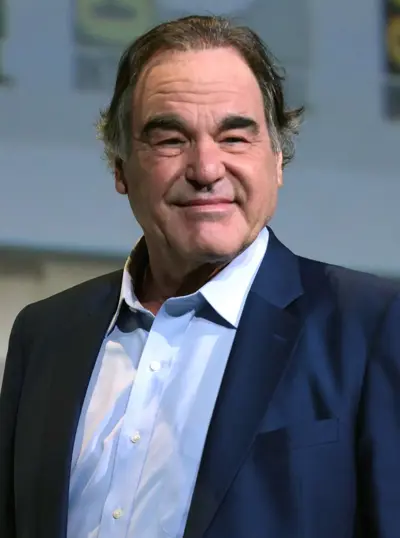
William Oliver Stone is an American film director, producer, and screenwriter. Stone won an Academy Award for Best Adapted Screenplay as writer of Midnight Express (1978), and wrote the gangster movie remake Scarface (1983). Stone achieved prominence as writer and director of the war drama Platoon (1986), which won Academy Awards for Best Director and Best Picture. Platoon was the first in a trilogy of films based on the Vietnam War, in which Stone served as an infantry soldier. He continued the series with Born on the Fourth of July (1989)—for which Stone won his second Best Director Oscar—and Heaven & Earth (1993). Stone's other works include the Salvadoran Civil War-based drama Salvador (1986); the financial drama Wall Street (1987) and its sequel Money Never Sleeps (2010); the Jim Morrison biographical film The Doors (1991); the satirical black comedy crime film Natural Born Killers (1994); a trilogy of films based on the American Presidency: JFK (1991), Nixon (1995), and W. (2008); and Snowden (2016).
