Karl Marx Quotes
To say that the newspaper press represents public opinion is to administer insult to intelligent men. It is the property of speculators, political leaders, large contractors and railway directors.
Karl Marx, 1818-1883, German Economist & Socialist, Quoted in Seldes, The Great Quotations, Citadel, 1983
Sourced by: Eigen's Political and Historical Quotations


Sherman felt that the newspapers of North and South fired up hatred of one side against the other and especially in the South, falsely reported the chances of the Confederacy and made rational Southerners who wanted to minimize the death and destruction to their people were made to feel like traitors and cowards.

Vladimir Lenin. Lenin was echoing criticisms that were made the world over and even by some in the United States. However, his solution to have the press controlled by the ruling party just changed the cast of characters who were propagandizing and distorting the truth. Lenin was not able to offer a better solution nor were others. However, with enough affluence the capitalist society produced enough different publishers all competing that one did not dominate public opinion. With technology of TV and the Internet, the bar to entry is so small that almost anyone can be a publisher and find an interested market. In a way technology has solved much of the problem for capitalistic and totalitarian societies alike. In the latter, even censorship is not easy or feasible on a large scale.


This is perhaps a situation that has existed in every country ever where the press was not controlled.


It was not true in 1922, nor has it been true since despite the fact that this is claimed and sincerely believed by some Americans. This has been a canard of a small minority of conservatives and radical leftists.

The queen was a lot more sophisticated about the newspapers than politicians in the 21st century.

This quotation Incorporates the famous observation of Joseph de Maistre that "every nation gets the government it deserves." {606135}.


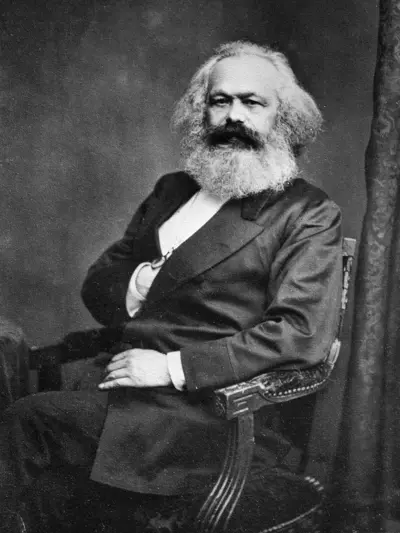
Karl Heinrich Marx was a German philosopher, economist, historian, sociologist, political theorist, journalist and socialist revolutionary. Born in Trier, Germany, Marx studied law and philosophy at university. He married Jenny von Westphalen in 1843. Due to his political publications, Marx became stateless and lived in exile with his wife and children in London for decades, where he continued to develop his thought in collaboration with German thinker Friedrich Engels and publish his writings, researching in the reading room of the British Museum. His best-known titles are the 1848 pamphlet The Communist Manifesto and the three-volume Das Kapital (1867–1883). Marx's political and philosophical thought had enormous influence on subsequent intellectual, economic and political history. His name has been used as an adjective, a noun, and a school of social theory.
