Paul Krugman Quotes
The media are desperately afraid of being accused of bias. And that's partly because there's a whole machine out there, an organized attempt to accuse them of bias whenever they say anything that the Right doesn't like. So rather than really try to report things objectively, they settle for being even-handed, which is not the same thing. One of my lines in a column -- in which a number of people thought I was insulting them personally -- was that if Bush said the Earth was flat, the mainstream media would have stories with the headline: 'Shape of Earth--Views Differ.' Then they'd quote some Democrats saying that it was round.
Until the 20th century almost all American political media were shamelessly and overtly biased—left or right. Political Parties had their own de facto publications much like Fox News became for the Republicans in the 21st century. In the 20th century journalism developed into a profession that evolved standards of objectivity in reporting. That norm then prevailed for about 70 years. With the extreme polarization of the later years of the 29th Century the right wing began to accuse much of the media of a left wing bias, and the media tended to react as Krugman describes in this quotation. The model of having spokespersons for “each side” of an issue works for highly subjective political preferences with a two party system, but where it broke down is with scientific and technical issues. On these, there often really are not two scientific points of view, but there is a scientific consensus of the vast majority of scientists and almost all the prestigious and accomplished scientists are in accord. However, there may be some who have a cultural, religious and/or political concern for some science and its implications for society. They in turn find a scientist or two, often one who is unaccomplished and not recognized in the scientific field to argue a different point of view. The media have tended to equate the two and have a “debate” as if there were two sides to the science when there are not. These issues tend to cluster around scientific medical issues involving sex and birth control methods, environment and conservation, evolution, the age of the earth and the method of creation of the universe. The problem is particularly exacerbated by the general scientific illiteracy of the American population and the relatively few journalists who themselves are scientifically literate who can explain scientific issues well.
Paul Krugman, Economist & Political Columnist, >Nobel Laureate in Economics, 2005
Sourced by: Eigen's Political and Historical Quotations


Fox News was the first major television news channel in the United States to represent a partisan political position—in this case Republican conservative. Although this was a first for TV, in American history most newspapers were openly partisan until the latter half of the 20th century. The Third Reich reference was to Nazi Germany which had extremely partisan media control of German media of the day.


Otehr members of the Trump staff then started to echo the notion and it became common in Trumpian circles.


He was responding to criticism that the media was bashing the President.

Husayn Ali Nuri


At the time, one of the favorite right wing accusations that the media were all biased in favor of liberal points of view. Any time a news story was covered that implied or showed that right wing ideology might be wrong, the conservatives would cry “liberal bias” without addressing whether the objection was sound or not. Often the most extreme right wing views are ideological and flaunt reality. Colbert turned this into a very funny phrase.


McCarthy was in many ways like Donald Trump. One was taht the press loved to cover his statements and accusations that were so absurd and sensational that they sold a lot of nespapers, magazines and obtained many TV / Radio viewers/listeners. As a result he got much more media coverage that he warranted in teh view of many, President Dwight Eisenhower, who generally would not even mention McCarthy's name was percieved by Adlai Stephenson and many others as weak and fearful of McCarthy, Tannenhous and some other historians believed that fear had nothing to do with it, but that Eisenhower not only chose this as a deliberate strategy, but one that was quite effective.

Many scholars believe that complete objectivity is impossible psychologically. Hence, neutrality is a better standard and goal some argue.


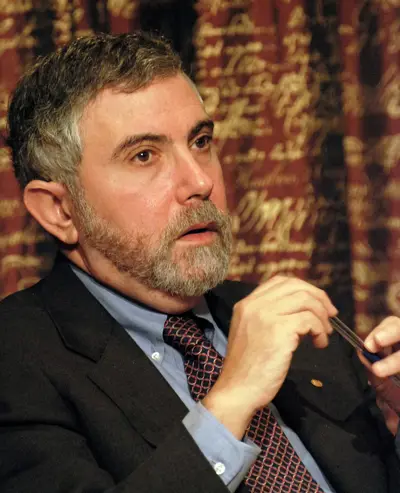
Paul Robin Krugman is an American economist who is the Distinguished Professor of Economics at the Graduate Center of the City University of New York, and a columnist for The New York Times. In 2008, Krugman was awarded the Nobel Memorial Prize in Economic Sciences for his contributions to New Trade Theory and New Economic Geography. The Prize Committee cited Krugman's work explaining the patterns of international trade and the geographic distribution of economic activity, by examining the effects of economies of scale and of consumer preferences for diverse goods and services.
