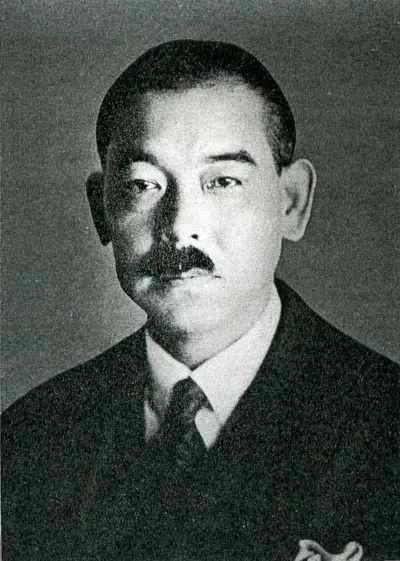
Yosuke Matsuoka Quotes
Japan will oppose any attempt at international control of Manchuria. It does not mean that we defy you, because Manchuria belongs to us by right …Read your history. We recovered Manchuria from Russia. We made it what it is today …. We look into the gloom of the future and can see no certain gleam of light before us … Would the American people agree to such control of the Panama Canal Zone; would the British permit it over Egypt?
Japan, then a militaristic power in the East had occupied and controlled Manchuria after the Russo-Japanese War. The League of Nations voted that Manchuria should be placed under international control until elections and independence can be arranged. The Japanese then had a rapidly growing population and Japan felt that the Japanese Islands were not sufficient to produce the raw materials, oil and agriculture needed to sustain a larger Japanese population. Therefore, the Japanese argued that they were entitled to grow and expand to nearby territories to provide for their nation’s needs. When the league of nations rejected the Japanese position, Japan walked out of the League of Nations. Japan would occupy part of China and Korea all leading to WWII. See {627075} for the foreign minister’s later assessment.
Yosuke Matsuoka, 1880-1946, Foreign Minister of Japan, Statement to the League of Nations, February 24, 1933
Sourced by: Eigen's Political and Historical Quotations
Japan, then a militaristic power in the East had occupied and controlled Manchuria after the Russo-Japanese War. The League of Nations voted that Manchuria should be placed under international control until elections and independence can be arranged. (See {627074}.) The Japanese then had a rapidly growing population and Japan felt that the Japanese Islands were not sufficient to produce the raw materials, oil and agriculture needed to sustain a larger Japanese population. Therefore, the Japanese argued that they were entitled to grow and expand to nearby territories to provide for their nation’s needs. When the league of nations rejected the Japanese position, Japan walked out of the League of Nations. Japan would occupy part of China and Korea all leading to WWII.
The Japanese diplomats of the day maintained that in addition to the special needs of Japan {616181} and {616183}, the “white” powers had colonies and if they left Korea, white nations would simply come in and annex it as a colony. The Japanese saw this as a double standard—white nations could have colonies but Asian nations, no. In reality, Colonialism was fading even in the white nations but Japan was coming to it anew. Their timing was on the wrong cusp of history. The example of Ireland transformed to an independent republic shortly thereafter. For colonialism, the handwriting was on the wall but the Japanese preferred not to look at the trend but the then status quo.
This is a classic example of an agreement of two colonial powers on the fate of a third, weaker nation—in this case Korea. Essentially, the English agree that Japan will control Korea so long as they maintain English commercial opportunities and rights there. Korea, of course, was not even consulted.
Russia was expansionistic even before the 1914 Russian Revolution with the Communists prevailing. I this case, they had designs on Korea. However, so did Japan and the two would fight in the Russo-Japanese War. Of course neither were concerned with what the Koreans wanted which was independence.
They were both children of Queen Victoria of England.
A few months later, that is exactly what Germany did. She was hoping that England would not enter the war despite her treaty obligations, but she was willing to risk the possibility. The Czar had a strong espionage and intelligence service active in Germany, but, like so many other intelligence failures, the intelligence operatives and analysts had military and economic facts but had little understanding of the German culture which propelled Germany to what to most other cultures was “irrational policy making.” People and nations often engage in irrational activities, even against their own self-interest.
The Japanese Government was in the control of ardent militarists intent on expanding the Japanese empire. They invaded Manchuria and had designs on China. The League of Nations was very weak, in large part because the United States had not joined when the Senate refused to ratify the treaty. So peace or war In Asia depended on the fascist, military clique that ruled Japan.
This was an amazing prediction for the time. Most Europeans were not sure that the United States would even survive, and Russia was looked upon as the most backward nation in Europe. By the middle of the 20th century—over 100 years after Tocqueville wrote this—The United States and Russia were the two superpowers of the world.
De Gaulle tended to see world affairs in terms of extreme, simplistic, and dramatic alternatives when reality is much more complex the truth was turned out to be for England a much more favorable outcome without either of these extremes.
This was the 14th part of the Japanese reply to a previously made American peace proposal. The Japanese policy was to unite all of Asia into a co-prosperity sphere controlled by Japan where Japan would militarily conquer those Asian countries which did not “voluntarily” want to join. The Japanese were in the process of conquering China and the United States and Britain had embargoed oil and other material to Japan trying to pressure them to withdraw their troops from China and cease Japanese conquest by force. Japan believed that it was their right to conquer and control Asia and it was beneficial to the region, and that the U. S. and Britain had no right to curtail the expansion that Japan required to assure raw materials and other necessities. At the very time that these negotiations were on going, the Japanese fleet was sailing for the sneak attack on Pearl Harbor. The attack took place the very day this part of the Japanese reply was received.