Elizabeth Cady Stanton Quotes
It was just so in the American Revolution, in 1776, the first delicacy the men threw overboard in Boston harbor was the tea, woman's favorite beverage. The tobacco and whiskey, though heavily taxed, they clung to with the tenacity of the devil-fish.
Stanton, Elizabeth Cady. Elizabeth Cady Stanton As Revealed in Her Letters, Diary and Reminiscences. Edited by Theodore Stanton and Harriot Stanton Blatch, vol. 2, Harper & Brothers, 1922.


The crackdown on Boston which was intended to set an example and intimidate all of the other colonies backfired, and the British were told about it by their own officials in America. But they were so rigid and ideological about monarchy, that the stimulated rebellion rather than suppress them.

It was repealed the next year, but much damage had been done to the relationship between the American Colonists and the mother country. It set the tone for American transition to a desire for independence. . Fox, a conservative on most issues was an absolute radical on the issue of America. To aggravate the hawks in parliament, he used to dress in the colors of George Washington’s uniform to show his support once the war broke out.


The British had closed Boston Harbor until the English merchants who lost their goods at the Boston Tea Party were paid for their damages. A convention was called to discuss a response to the closing of Boston Harbor and New York City convened a public meeting to come up with instructions for their delegates to the conference. One amazing thing was that they advocated a boycott of English goods. What was amazing was that there was no nation and New York and Massachusetts were separate entities and sectionalism was rife, yet New Yorkers were willing to sacrifice to help Bostonians. The New York sacrifice was all the greater because most of the imports from England landed at New York harbor where there was work created for New Yorkers and business for New York companies. New York stood to lose the most with a boycott. Philadelphia which also advocated a boycott, lost little as they were not a harbor for imports. New Yorkers also provided assistance to their competitors, the Bostonians who were out of work. See {589413}.


The treaty ending the Revolutionary war guaranteed that the English bankers and merchants who had debts going back to before the American Revo
lution would have “no impediment” in collecting their debts in America. However, Rhode Island and Virginia in particular placed many impediments and made it virtually impossible for debts to be collected in their states. The John Jay led Supreme Court, in particular, overturned state actions on the grounds that they had implemented Patrick Henry’s sentiment and hence violated the treaty.

He was acting as French Foreign Secretary at the time.

In South Carolina, the Patriots, in reaction to the Tea Tax, did not destroy the tea, but stopped it from being landed and sold. Finally Lt. Governor Bull had the tea moved into the Customs house in Charleston. The patriots were satisfied that it was under lock and key and could not be sold or distributed and the tea tax was thus not collected. The British Secretary of State for America, however did not regard the compromise favorably.

Wilkes was a strong advocate for the American cause—so much so that some in Parliament tried to deny him his seat in Parliament for his disloyal point of view.

While the official battles of the American Revolution did not begin until 1776, parts of the American colonies were in a de facto state of rebellion and the British could not enforce their laws. See {636925} for another of the King’s statements.

This quotation shows 1) that the American Colonists saw their country to be as including Canada. See Thomas Jefferson for more on that point: {636940}. 2) That the Continental Congress misread the situation in Quebec assuming that the cultural values of New England were those of Quebec. Given the strong French tradition in Quebec, and the dependence on trapping and trading, Quebec was quite different. Also, England had acted to secure Quebec militarily. See {636939}.
Note that Britain was blockading Boston in the middle of 1775, some time before the outbreak of battles in Concord and Lexington in 1776. What Gates did not tell Lord Dartmouth, and maybe did not know himself, was that the skilled Massachusetts sailors smuggled a great deal through the blockade in small boats at night landing in the many inlets and coves in the Boston area. Also, do not think of Boston in 1775 as today. At that time most people had, in the city, their own farms and gardens and grew much of their own food. The Boston Commons was a common area for grazing sheep. So the British Blockade of Boston was not very effective.

This is a very interesting quotation. A contemporary historian tells us how rapidly the American colonists organized when Parliament passed the Tea Tax. Even with the Internet and social media it would be hard to organize representation from 13 states that fast today. The word of mouth and mail of the day was surprising to most of us. The passion on the issue and the public interest must have been extraordinary. Ramsay was the first major historian of the American Revolution.

During the American Revolution, conditions were very difficult for Washington’s soldiers who were ill armed, ill clothed, and ill fed while they were paid irregularly. At one point morale was so low that some of the soldiers revolted. Smyth observes that Washington and Congress disciplined the mutineers very mildly, especially when compared with the way the British would deal with such things. The British Governor Clinton tried to take advantage of the mutiny and the poor morale by announcing that all of Washington’s troops who wished could obtain amnesty and join the British forces where the pay and conditions were much better. Professor Smyth found it fascinating that none of the Americans would join the British and he credits it to the wise and mild discipline policies of Washington and Congress as well as the general perception of the justice of the American cause among the American troops.

Franklin was also an accomplished political cartoonist.


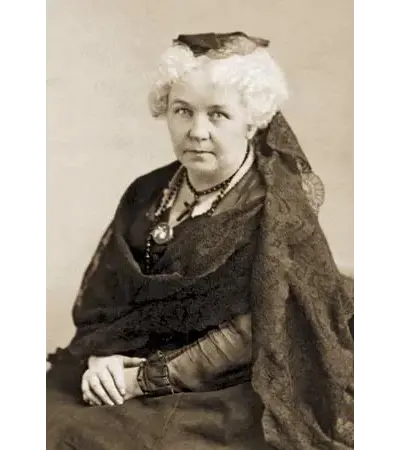
Elizabeth Cady Stanton was a leader of the women's rights movement in the U.S. during the mid- to late-1800s. She was the main force behind the 1848 Seneca Falls Convention, the first convention to be called for the sole purpose of discussing women's rights, and was the primary author of its Declaration of Sentiments. Her demand for women's right to vote generated a controversy at the convention but quickly became a central tenet of the women's movement. She was also active in other social reform activities, especially abolitionism.
