NEW YORK CITY
(City of New York)
The Shereth Israel congregation was the first organized Jewish congregation in America. Traditionally, in Europe the congregation would appoint a butcher to ritually slaughter animals and sell them to the congregation members at controlled prices. However, a New York butcher of the time decided that since America was a free country, he would sell directly to Jews and not go through the congregation, thus avoiding the price fixing which he thought unfairly low. The congregation responded as they traditionally had in Europe and asked the civil authorities to enforce their right to control religious activities in the community. The City Council then passed this law. The butcher appealed to the courts which ruled that he had the right to sell his meat regardless of the congregation—that the American law may not be used to enforce any religious tradition. The case set important precedents regarding the relationship between church and state, monopolies, and individual commercial rights.
This is an invaluable historical quotation showing urban housing conditions in the 1920s.
The British had closed Boston Harbor until the English merchants who lost their goods at the Boston Tea Party were paid for their damages. A convention was called to discuss a response to the closing of Boston Harbor and New York City convened a public meeting to come up with instructions for their delegates to the conference. One amazing thing was that they advocated a boycott of English goods. What was amazing was that there was no nation and New York and Massachusetts were separate entities and sectionalism was rife, yet New Yorkers were willing to sacrifice to help Bostonians. The New York sacrifice was all the greater because most of the imports from England landed at New York harbor where there was work created for New Yorkers and business for New York companies. New York stood to lose the most with a boycott. Philadelphia which also advocated a boycott, lost little as they were not a harbor for imports. New Yorkers also provided assistance to their competitors, the Bostonians who were out of work. See {589413}.
The British had closed Boston Harbor until the English merchants who lost their goods at the Boston Tea Party were paid for their damages. Even though Boston being the second port in the colonies after New York were commercial competitors to the New Yorkers. None the less, New York raised money for assistance to the Bostonians who were jobless as a result of the port closure. See {589414} for the other steps that New York was willing to take.
New York originally started its own radio station to educate immigrants and newcomers, and over the years it has become one of the leading National Public Radio stations with a regional audience. It is actually operated by the city which also has its own television station.
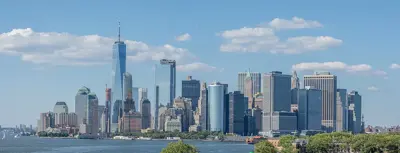
New York City (NYC), often simply called New York, is the most populous city in the United States. With an estimated 2019 population of 8,336,817 distributed over about 302.6 square miles (784 km2), New York City is also the most densely populated major city in the United States. Located at the southern tip of the State of New York, the city is the center of the New York metropolitan area, the largest metropolitan area in the world by urban landmass. With almost 20 million people in its metropolitan statistical area and approximately 23 million in its combined statistical area, it is one of the world's most populous megacities. New York City has been described as the cultural, financial, and media capital of the world, significantly influencing commerce, entertainment, research, technology, education, politics, tourism, art, fashion, and sports, and is the most photographed city in the world. Home to the headquarters of the United Nations, New York is an important center for international diplomacy, and has sometimes been called the capital of the world.
