Paul Revere Quotes
In the Fall of 1774 & Winter of 1775, I was one of upwards of thirty, chiefly mechanics, who formed ourselves into a committee for the purpose of watching the movements of the British soldiers, and gaining every intelligence of the movements of the Tories.
Revere, Paul. "A Letter from Col. Paul Revere to the Corresponding Secretary." Collections of the Massachusetts Historical Society, vol. 5, Massachusetts Historical Society, 1798, p. 106.

This is a very interesting quotation. A contemporary historian tells us how rapidly the American colonists organized when Parliament passed the Tea Tax. Even with the Internet and social media it would be hard to organize representation from 13 states that fast today. The word of mouth and mail of the day was surprising to most of us. The passion on the issue and the public interest must have been extraordinary. Ramsay was the first major historian of the American Revolution.

The crackdown on Boston which was intended to set an example and intimidate all of the other colonies backfired, and the British were told about it by their own officials in America. But they were so rigid and ideological about monarchy, that the stimulated rebellion rather than suppress them.


The State of Massachusetts, which was opposed to the war of 1812, withdrew its militia from Federal service and was threatening to declare itself neutral in the war.


Today, most Americans know little of Samuel Adams but see John Adams as a much larger and more important figure. But for the American Patriots fighting the Revolution, it was Sam Adams who made the most outstanding contributions to the political strategy and leadership.

Franklin was also an accomplished political cartoonist.


2nd Earl of Guilford. This bill cut off all trade with the American Colonies. It was meant as pressure to cease the rebellion. It did not work.

Lord Dunsmore was John Murray, 1732-1809, the Royal Colonial Governor of Virginia who was one of the least competent of the British officials in Colonial America.
Mechanics was a general term for people who made things, or fixed things. Ramsay was the first major historian of the American Revolution.


Note that Britain was blockading Boston in the middle of 1775, some time before the outbreak of battles in Concord and Lexington in 1776. What Gates did not tell Lord Dartmouth, and maybe did not know himself, was that the skilled Massachusetts sailors smuggled a great deal through the blockade in small boats at night landing in the many inlets and coves in the Boston area. Also, do not think of Boston in 1775 as today. At that time most people had, in the city, their own farms and gardens and grew much of their own food. The Boston Commons was a common area for grazing sheep. So the British Blockade of Boston was not very effective.
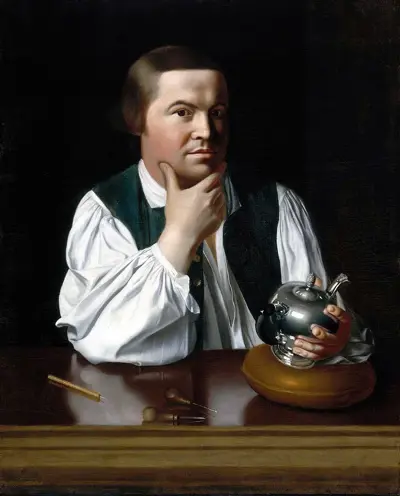
Paul Revere .
