Ely S. Parker Quotes
It is presumed that humanity dictated the original policy of the removal and concentration of the Indians in the West to save them from threatened extinction. But today, by reason of the immense augmentation of the American population, and the extension of their settlements throughout the entire West, covering both slopes of the Rocky Mountains, the Indian races are more seriously threatened with a speedy extermination than ever before in the history of the country
The first Native American to become a General Officer. Appointed by President Grant in 1869
Ely S. Parker, 1828-1895, Donehogawa, Seneca Iroquois Indian Chief, Engineer, and Union General, First U. S. Commissioner of Indian Affairs State of Danger for the Indians
Sourced by: Eigen's Political and Historical Quotations

First Indian to hold the position


This comprehensive report of 457 pages was written, printed and distributed at her expense prior to her Federal appointment.

Jackson’s policies regarding Indians set back all the work of the earlier Presidents and created facts on the ground and attitudes that vex us to this day. In this occasion he said very forthrightly that it was his intention to deny Indians title to ANY land in the then United States. His idea was to send all the Indians to the Oklahoma Indian Territory and establish reservations for them there. Of course, as the Western states joined the Union, the Whites wanted those Indian Lands as well. See {643150} for other Jackson views on Indian policy.

He was a brutal officer who by modern standards committed various war crimes.


Large wagon trains of settlers crossed the content on their way to the Oregon Territory. The Sioux Indians whose land the wagon trains had to pass through often attacked the wagon trains in a vain effort to discourage others from passing through the area. The Sioux believed that the large wagon trains frightened the buffalo away, which was probably not a significant factor in the diminishing of the buffalo herds. The Indians and white hunters both over-hunted the buffalo which became few in numbers. With modern wildlife management Buffalo are not only back but are plentiful and being raised for their lean meat which has become a delicacy.

First Indian newspaper in the U.S.

Shabonee in a warning ride reminiscent of Paul Revere, warned many white settlers of an impending attack by unfriendly Indians. He also gave an eyewitness account of the Battle of Tippecanoe which propelled Harrison to the Presidency. The U. S. Navy named a ship in his honor in the 1940s. Several schools are named for him also.

Published 100 years after it was written. This is the first known written statement of what became a de facto policy regarding the American Indian.


Wayne played so many parts depicting whites in the process of expanding Westward that many people saw him as an expert on the history of the Westward Expansion. He did not comment on the whites who then kept huge ranches “selfishly” for themselves or those who selfishly would not share the mineral rich land that they had taken with anyone including the original Indian owners. So in this view, the Indians should have not been capitalists but they should have been socialists and shared their resources.

Carson was one of the few Indian Agents who spent every penny of his budget on the Indians as opposed to himself. He was married to an Indian woman and was close enough to many Indians that he understood their resentment whenever they came into a town. They were treated terribly and while most of them were literally starving, seeing the white opulence produced resentment.

At the time, Jefferson was the Governor of Virginia and the Indians and white settlers in the Western part of the state were coming into increasing conflict. This rather heartless and blood thirsty quotation of Jefferson’s surprises many of his great admirers. Especially because of his historical sophisticated and empathetic way he treated Indians. See {589102}, {589103}, {589113}, {589125}, and {605068}. Jefferson saw Indians much like he saw whites—differentially. Some were friends, some neutral, and some dangerous enemies. His wish to exterminate or ethnically cleanse these Indians was limited to these Indians—not to Indians in general. Nonetheless, it shows a violent side of Jefferson that was in play with enemies. As President, he was aggressive against the Muslim Pirates (see {623707} and {617123}).


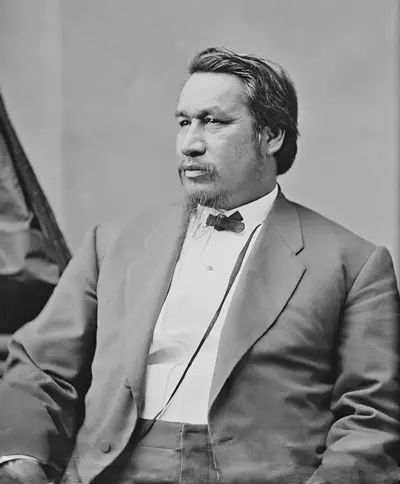
Ely Samuel Parker, born Hasanoanda, later known as Donehogawa, was a Tonawanda Seneca U.S. Army officer, attorney, engineer, and tribal diplomat. He was commissioned a lieutenant colonel during the American Civil War, when he served as adjutant and secretary to General Ulysses S. Grant. He wrote the final draft of the Confederate surrender terms at Appomattox. Later in his career, Parker rose to the rank of brevet brigadier general. When Grant was elected president, he appointed Parker as Commissioner of Indian Affairs, the first Native American to hold that post.
