John Winthrop Quotes
It is not hard to prove, that the lawmakers, in all states, have committed more, and more pernicious errors than the judges
John Winthrop, 1588-1649, Puritan Clergyman, Governor, Massachusetts Bay Colony, Arbitrary government described and the Government of the Massachusetts vindicated from that aspersion, 1644
Sourced by: Eigen's Political and Historical Quotations


In every case except Obamacare, the Congress would pass technical correctional amendments as programs were implemented and glitches were found. However, with Obamacare, ultra conservatives were strongly opposed to it, and after the law passed over their opposition, they tried (unsuccessfully) to repeal it dozens of times. When technical glitches began to appear, they blocked correcting legislation on the political thinking that the defects would anger people and produce more support for repeal. Trumka observed that the conservatives had also bitterly opposed Social Security in 1936, but in the following years worked to pass correcting amendments and eliminate technical flaws. This was the first piece of major legislation that a substantial number of one of a political party members of Congress tried to sabotage the program and had enough intimidation power over the party leadership and statesmen, that they were enabled.


This early New England law illustrates some interesting aspects of Colonial law enforcement and philosophy. Massachusetts was perhaps the most religiously rigid and orthodox of the colonies. Yet in the case of rape, they did not always follow the Mosaic Law as some other colonies did. Instead, they had the concept of judicial discretion built into their sentencing. The other point of interest is that there was an “age of consent” albeit, for a female it was 10 years old.


The New Hampshire House of Representatives is the second largest legislative body in the world with 400 representatives.


For complex legislation, there are very few members of Congress who vote on the legislation who could honestly say that they have read the entire bill. Breyer and many others do not see this as a major problem; many others consider it a disgrace that members of Congress will vote for or against a law that they have not even read.

Lott and other Republicans who objected to Democratic Filibusters of a few judges. Later in the Obama administration he and Republicans had no problem when the Republican Senate minority filibustered just about everything—nominations, laws, budgets, treaties. They had more filibusters in that Congress than there had been in all of Senate history. It is always an issue of whose ox is gored with rampant hypocrisy on both sides in dealing with the filibuster concept. However, no majority in recent years has tried to change the filibuster, though the majority always complains about it.

Originally it was published in Boston under the name “A Columbian Patriot.” The “principles to which she referred were the principles set out in our Constitution of 1787.


This is the justification of virtually all legislatures that exempt their members from general requirements of law or grant them special privileges. Occasionally, the justification is warranted; most often, not.

In general, there are so many versions of a bill as it goes through the Congressional process, that the members of Congress do not read each and every draft. Some do not read any of the drafts and leave it to the Committee; others trust their staffs or their party leadership. More often they trust the lobbyists who donate to their campaigns. Sometimes, the bills are so large—many thousands of pages that the members of Congress lose track of all the aspects of the proposed law and only read a few sections in which they may have participated in debate. Often, the only people who read the entire bill are the lobbyists and one or two of committee staff.

In the struggle for political power, this is often forgotten. During the Barak Administration, the President proposed measures that had been introduced and supported by his Republican opponents earlier. But they then not only failed to support them but often filibustered in the Senate to block them. The Democrats failed to support some of their ideas when President Eisenhower introduced them.

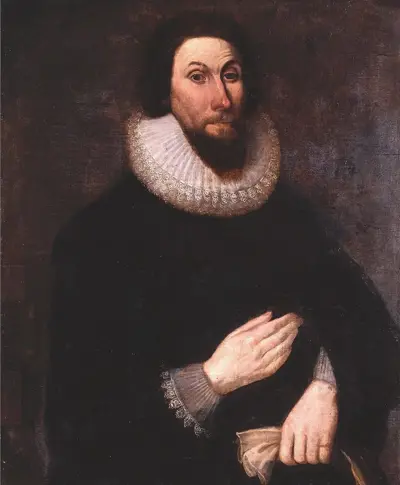
John Winthrop was an English Puritan lawyer and one of the leading figures in founding the Massachusetts Bay Colony, the second major settlement in New England following Plymouth Colony. Winthrop led the first large wave of colonists from England in 1630 and served as governor for 12 of the colony's first 20 years. His writings and vision of the colony as a Puritan "city upon a hill" dominated New England colonial development, influencing the governments and religions of neighboring colonies.
