John Lehman Quotes
Congressional anarchy must be curtailed.
John F. Lehman, Secretary of the Navy, Command of the Seas, Charles Scribner's Sons, 1989
Sourced by: Eigen's Political and Historical Quotations


His main reason for believing this is that all appropriations bills must be initiated by the House of Representatives. Lobbyists therefore often give the House more attention than the Senate.


In the early years of the Obama Administration, the minority leader of the Senate declared that the object of the Republicans in the Senate was to prevent Obama from being reelected. Therefore, the Republicans used the filibuster to block virtually all legislation. In 2010, the Republicans gained control of the House of Representatives and would not pass any legislation that the President favored lest he get credit for accomplishing something. It had gotten so bad, that even when the President proposed Republican ideas about which everyone agreed, that too was blocked.


In the beginning of the 21st century political hyper-polarization made Congressional gridlock the norm. Anything that was acceptable to the Democrats would be rejected by the Republicans and vica versa. However, at times, the public would be impassioned by events and demand Congressional action. A movement for gun control after a serious of massacres with assault weapons in 2012 was the example that Thomas was using. If the legislative process could be stretched out until public passions waned, the normal gridlo{78528}k would control and there would be no reform.


This was one of the worst Congresses in American History and had the worst productivity record—passing very few bills, and none of any significance. The anti-government, Tea Party hyper-conservative Wing of the Republican Party intimidated the Speaker of the House and they were opposed to any compromise at all on anything.


The Senate had always been more deliberative than the House, but at the time Alexander made this statement, his party—the minority in the Senate—had filibustered most of all the legislation, There were more filibusters than had occurred in the entire pure history of America.

In general, there are so many versions of a bill as it goes through the Congressional process, that the members of Congress do not read each and every draft. Some do not read any of the drafts and leave it to the Committee; others trust their staffs or their party leadership. More often they trust the lobbyists who donate to their campaigns. Sometimes, the bills are so large—many thousands of pages that the members of Congress lose track of all the aspects of the proposed law and only read a few sections in which they may have participated in debate. Often, the only people who read the entire bill are the lobbyists and one or two of committee staff.


At the time Congress was gridlocked in bitter hyperpartisan conflict. Most people called for more comity and bipartisanship and most politicians wanted more bipartisanship but blamed the other party for the rift. Mourdock, arguing for less bipartisanship and no compromise defeated Richard Lugar in the Republican Senatorial Primary election. Lugar, one of the most respected and effective Senators was a statesman who worked with any and all to find effective compromises to reach national solutions. The nation was so politically polarized that the Republican Indiana voters ousted one of their most senior senators because he was effective at developing national solutions. See {626717} and {302706} for other Mourdock’s outrageous comments. While this rhetoric won in the Primary, it lost him the general election in a state where Republicans had a strong majority and should have had the seat.


If a party controls one of the two houses of Congress, they can block any legislation. But governing involves passing legislation, and in our bi-cameral Congress, control of one house is not sufficient to pass legislation.


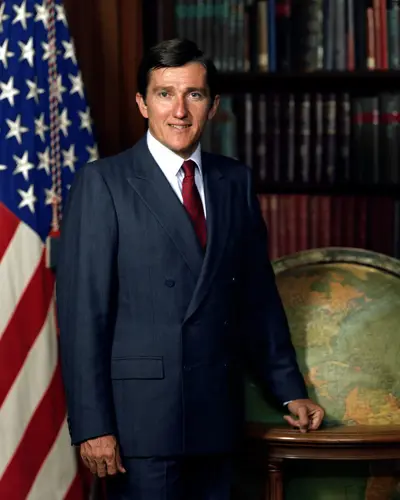
John Francis Lehman Jr. is an American private equity investor and writer who served as Secretary of the Navy (1981–1987) in the Ronald Reagan administration where he promoted the creation of a 600-ship Navy. From 2003 to 2004 he was a member of the 9/11 Commission.
