Stuart Symington Quotes
It all went back to problems we had talked about before, you know, such as the British not believing in formation bombing and not believing in daytime bombing.
Symington, Stuart. Oral History Interview with Stuart Symington. Interview by James R. Fuchs. Harry S. Truman Library and Museum, 1981.

Some scholars look back at the allied bombing of German Cities in WWII with criticism that it was morally improper to bomb populated cities, and that the use of the adjective “exterminating” indicated that Churchill was more interested in killing Germans than strategic victory. This revisionist history has two failings. First, the Germans had already bombed Coventry, London and other civilian targets in England as well as cities in Holland, Poland and other countries killing many civilians. As a result, under the rules of war, Germany was no longer entitled to protection for their cities. Further, Hamburg and other targets were manufacturing sites of war material and as such lost the protection anyway. Even Dresden, which had very little war manufacturing was the main location for R&R of German Officers and by their military presence in the city converted it into a legitimate target. FDR agreed with Churchill, that the bombing was a good strategy to cause Hitler to fall as they thought the public would rebel. They were wrong however and his grip on the population through the Gestapo and the military was so strong that, it took a land invasion and occupation to put an end to Hitler. However, the devastating bombing all but crippled the German weapons development and deployment. For example. The Germans had developed the Jet Airplane Engine and actually put a few in the fight at the end if the war. Without the bombing, they would have had many more and countered the allied air supremacy. However, it is also true that Churchill and many Englishmen and some Americans believed that the English were morally entitled to retaliation for the innocent civilians killed with the German bombing of civilian targets.


60,000 English men, women, and children had been killed by German terror bombing of London and other English cities. The policy had been to retaliate and bomb German population centers. Over 4 million British homes had been destroyed by the blitz and Churchill was becoming concerned that when the Allies would occupy Germany shortly, there would be no German housing left for the civilian population much less for the Allied occupying forces. Churchill’s Air Attaché persuaded him NOT to send the memorandum with it’s references to the terror bombing in retaliation. The memorandum was rewritten with the references to “terror” removed. The bombing of cities did stop as a result.

One of the predictions of the oncoming war with Germany.


This appears to be the first public call for Anti-Ballistic Missile Weapons & Systems. To many it is surprising that in 1946, there would be concern about missile defense, however during WWII, the Germans, violating the laws of war, struck London and other English cities with V2 rocket—the first ballistic missiles. England had suffered many civilian casualties and missile defense was a high priority for them.

The only soldier ever so honored. See {604732} for Japanese attitude toward surrender.


of the German tactics of Blitzkrieg Goering, Hitler and the other leading Nazis were quite open about their military aggression. Terrorism was admittedly used to persuade the next nation Germany would attack to capitulate rapidly.

Hopkins was a social worker with no military of political experience. But the President trusted him implicitly. Most American military officers and Ambassador to England Joseph P. Kennedy, a Nazi sympathizer & father of JFK, believed that England could not stand up to Hitler. Any military aid we gave England would fall into the hands of the Germans. Everyone was shocked when Roosevelt sent Hopkins to England to make a military recommendation. To impress Hopkins with something he thought Hopkins would be interested in, Churchill led a tour of workers cottages built by the government. Hopkins surprised Churchill and his aids who would never forget this statement & then asked to see the military facilities. Hopkins distressed the American military by recommending that Britain could hold out against invasion if they received military aid. Despite the contrary military advice, FDR accepted Hopkins’ recommendations, and the rest is history. He had been right and much of the military wrong.

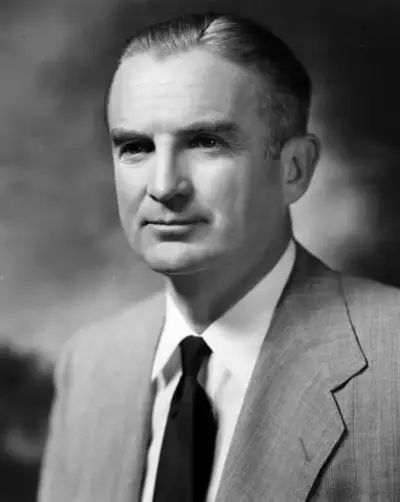
William Stuart Symington III was an American businessman and Democratic politician from Missouri. He served as the first Secretary of the Air Force from 1947 to 1950 and was a United States Senator from Missouri from 1953 to 1976.
