Jan Christiaan Smuts Quotes
The day may not be far off when aerial operations with their devastation of enemy lands and destruction of industrial and populous centers on a vast scale may become the principle operation of the war, to which the older forms of military and naval operations may become secondary and subordinate.
Jan Christiaan Smuts, 1870-1950, Prime Minister, South Africa, Post WWI Report to Prime Minister David Lloyd George, Quoted in Richard Rhodes, The Making of the Atomic Bomb, 1986
Sourced by: Eigen's Political and Historical Quotations


There were few military thinkers at that time who would agree with Goebbels on this point.


He was the author of the first “spy novel” and one of the first English writers to use his art and craft to promote public opinion to support more military spending to defend against Germany.


The Germans saw this concern as partisan party politics and hysteria. See {594618}.

This appears to be the first public call for Anti-Ballistic Missile Weapons & Systems. To many it is surprising that in 1946, there would be concern about missile defense, however during WWII, the Germans, violating the laws of war, struck London and other English cities with V2 rocket—the first ballistic missiles. England had suffered many civilian casualties and missile defense was a high priority for them.


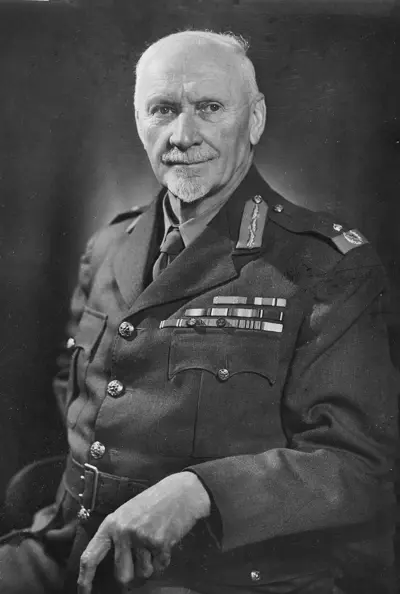
Field Marshal Jan Christiaan Smuts PC, OM, CH, DTD, ED, KC, FRS (24 May 1870 – 11 September 1950) was a South African statesman, military leader, and philosopher. In addition to holding various cabinet posts, he served as prime minister of the Union of South Africa from 1919 until 1924 and from 1939 until 1948. Although Smuts had originally advocated racial segregation and opposed the enfranchisement of black Africans, his views changed and he backed the Fagan Commission's findings that complete segregation was impossible. Smuts subsequently lost the 1948 election to hard-line Afrikaners who created apartheid. He continued to work for reconciliation and emphasized the British Commonwealth’s positive role until his death in 1950.
