Ferdinand Foch Quotes
Airplanes are interesting toys, but of no military value.
Ferdinand Foch, 1851–1929, French General, Supreme Commander of All Allied WWI Forces, 1911, Quoted in Time : A Traveler's Guide, 1998
Sourced by: Eigen's Political and Historical Quotations

Ataturk quickly envisioned the importance of the airplane. He even sent is daughter to Russia to learn to fly a plane, and she became the first Turkish Military Officer to do so. This was typical of Ataturk—killing two or more reform “birds” with one stone. He not only brought the airplane into the Turkish consciousness by having his daughter fly which attracted great attention of the press and got people talking, but showed that women were capable of the most complex technological tasks. Before Ataturk, few women in Turkey ever did anything but parenting and homemaking. Ataturk gave Turkish women the vote before America adopted women’s suffrage.


He had just seen demonstrations of new military technology at the German War Games.

He was the author of the first “spy novel” and one of the first English writers to use his art and craft to promote public opinion to support more military spending to defend against Germany.

At the time, most Japanese (and American and worldwide) Naval leaders and strategists believed that it was the battleship that was the critical naval weapon. Yamamoto proved to be correct and ironically, the American Aircraft Carriers and Planes were his undoing.

While this principle is usually true, the irony is that it did not hold for the Germans in WWII. Towards the end of the war, they had developed the first jet planes which in combat were far superior to anything the allies could contest them with. In every battle they shot down many more allied plans than they lost. However they had relatively few as allied bombers had destroyed key factories and already killed most of the German experienced pilots. Also the fuel facilities were crippled. So even though the German jets were technologically superior, they were so outnumbered that they were not strategicappy successful.
In large warfare at the time and in the American Civil War disease was responsible for more death than weapons. The logic is that with fewer troops necessary, there would be less disease. However, the reality was that machine guns never did reduce the number of soldiers—it only produced more lethal soldiers.

Commenting on the hostility which greeted some returning Vietnam veterans:


Later, he felt that the offense had become almost invincible. See {626741}. Tesla was one of the great American immigrant scientists. He found in America the kind of intellectual and operational freedom that did not exist in the rigid, monarch-controlled, Austro-Hungarian Empire. He developed patents and techniques that formed the technological bases of radio, telephone long distance, TV, cell phones, Wi Fi, just to name a few. Most important he was Thomas Edison’s great nemesis. Edison invented DC electric generators that could power factories or entire streets in a neighborhood. Tesler invented and developed AC electrical technology which could power entire cities and he could move electricity over long distances which Edison could not. Tesler was one of the first scientists to conceive of and try to implement “Big Science” where there were huge capital investments to develop machines and systems to do what had never been done before—philosophically like the CERN Hadron Collider. Tesler even convinced a large corporation to finance the construction of a massive building and tower so he could experiment with the wireless transmission of electricity. However, as the industrial democracies have learned, Big Science can only be funded by governments and it often takes sever working in consort to afford the huge investment that is required. In Tesler’s era, the federal and state governments did not fund scientific research so his work was not only technically ahead of his time but also conceptually. He anticipated most of the problems and need for a national power grid that was challenging America even at the beginning of the 21st century.

Cayley developed the first gliders and envisioned air travel at the same time that Thomas Jefferson was President.


In WWII as later, defense contractors and military weapons designers were always trying to improve the design and proto-models, thus stalling production and utilization. Arnold’s statement galvanized the program and B-29s reached the Pacific theater to help win the war.


During the presidential debates George W. Bush stated that he would be very hesitant to use the military for nation building around the world. Less than a year later, the Bush administration, faced with the September 11, 2001 terrorist attacks, launched a massive attack on the Taliban regime in Afghanistan. After fighting and winning the war, the military soon realized that they would in fact be involved in nation building. However, with the assistance of the United Nations much of the humanitarian burden was lifted from the U.S. military.
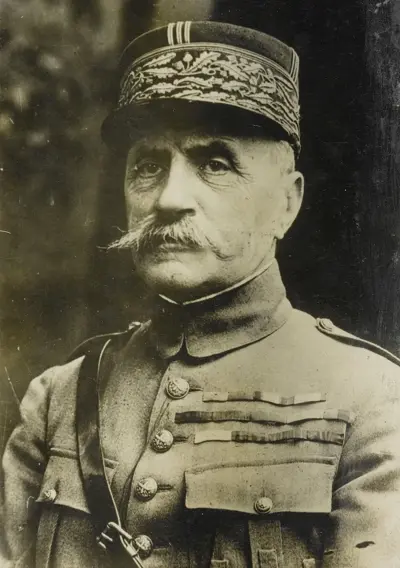
Ferdinand Foch was a French general and military theorist who served as the Supreme Allied Commander during the First World War. An aggressive, even reckless commander at the First Marne, Flanders and Artois campaigns of 1914–1916, Foch became the Allied Commander-in-Chief in late March 1918 in the face of the all-out German spring offensive, which pushed the Allies back using fresh soldiers and new tactics that trenches could not contain. He successfully coordinated the French, British and American efforts into a coherent whole, deftly handling his strategic reserves. He stopped the German offensive and launched a war-winning counterattack. In November 1918, Marshal Foch accepted the German cessation of hostilities and was present at the Armistice of 11 November 1918.
