Louisa Catherine Johnson Adams Quotes
If this is the vaunted superiority our Government and the purity of our elective institutions, I do not think we have so much to be proud of, and morality and religion are of little use if they cannot teach us to discern the difference between right and wrong.
The “compromise” admitted Misouri to the Union with the right to have slavery and Maine with the right to abolish slavery. The slave states had taken the position that states really had no right to abolish slavery at all, but they compromised on Maine. Many in the non slave states insisted on the aboloution of slavery everywhere, but compromised on Missouri. Luisa Adams, an implacable opponent of slavery on moral and religious grounds, condemned the compromise as politically expedient but morally bankrupt. She saw attempted compromise on the slavery issue as leading to disaster—current and future murder and degradation of human beings and postponing the issue until it would be out of hand.
Louisa Catherine Johnson Adams, 1775-1852, First Lady (John Quincy Adams), Reaction to the Congressional passage of the Missouri Compromise, 1820
Sourced by: Eigen's Political and Historical Quotations

Supreme Court Chief Justice Roger B. Taney, 1777-1864, had written the infamous Dred Scott decision requiring free states to return escaped slaves from the South. This decision widened the gap between North and South and made the Civil War almost inevitable. See {584921}.


Some whites began to understand the negative effect that slavery had on the Negroes. He like many Northerners interested in the rehabilitation of former slaves was convinced that a strong education program was necessary and the ex-slaves should not be dependent in their ex-masters for the education and acclimation to American life. However, with a President (Andrew Johnson) uninterested in Black development and a local white population totally opposed to such efforts only a little progress was made and the consequences affected America for the next 100 years.


As a key member of Lincoln’s cabinet, William H. Seward was most concerned with preserving The Union. However, since the Constitution was written in 1787, there had been compromises made with the pro slavery forces of the South to give them proportionally more political power and to avoid interfering with the institution of slavery. The Dred Scott Supreme Court decision forced the Northern States to actively cooperate in enforcing and maintaining slavery. Large numbers of abolitionists had reached their limit and wanted no more compromises regarding slavery. Mrs. Seward was one of those. This quotation also illustrates the influence that some women had in politics even though women could not vote. Frances Seward was very much a political partner with her husband who was favored to beat Lincoln for the Republican Presidential nomination.


One of the many complaints that many people made at the time about Smith and his Mormons was that they opposed slavery. In fact, Smith not only opposed it be had a plan for compensating the slave owner and a method for paying for it. Smith was not advocating the kinds of personal lifestyle issues of his church the way modern religious leaders do, but was concerned with the much larger issues of expansionism, corruption of the courts and judiciary, and land distribution. He was a classic reform candidate in that sense. Smith had written to most of the then likely Presidential candidates of both major parties asking for their position on the Mormons who were facing persecution wherever they went. None of the politicians would make any satisfactory commitments. Smith took Direct Action and became the only major religious official to have run for the Presidency of the United States until Pat Robertson tried and failed in 2000. Smith’s assassination shortly thereafter cut his run for the Presidency short before it made much headway and politically he had no chance to affect the race.


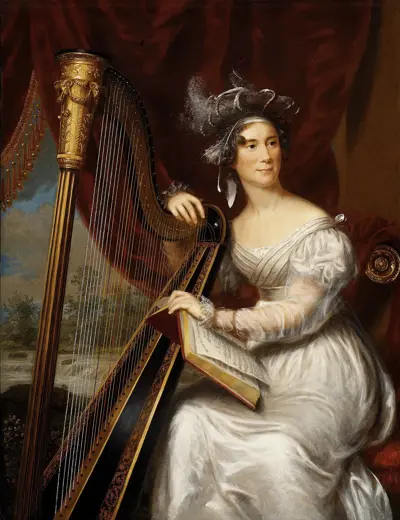
Louisa Catherine Adams was the First Lady of the United States from 1825 to 1829 during the presidency of John Quincy Adams. Born in London, she was the first First Lady to be born outside the United States or the preceding Thirteen Colonies—a distinction that would not be shared until 192 years later by Melania Trump.
