Ezra Stiles Ely Quotes
If they [elected politicians] ought to be just towards men, ought they not also to abstain from robbing God, and to render unto him that honour which is HIS due?
A conservative Calvinist weekly periodical. There has always been a religious right in America.
Ezra Stiles Ely, 1786-1861, Presbyterian Pastor in Philadelphia, Editor, The Philadelphian The Duty Of Christian Freemen To Elect Christian Rulers: A Discourse Delivered On The Fourth Of July, 1827 In The Seventh Presbyterian Church In Philadelphia
Sourced by: Eigen's Political and Historical Quotations


This verse has been one of the bases of Muslim theocratic states like Iran’s claim to legitimacy. The word “govern” is sometimes translated as “judge.” In the context of the 6th century, there were no separation of powers as we know them and judging, governing and legislating were melded.


Jefferson wrote his friend that the New England clergy had opposed him because he would block their efforts to merge church and state. Inscribed in the rotunda of the Jefferson Memorial in Washington DC. The third sentence is often quoted without the first two.


See John Leland for opposition to this clause: {608955}


Philip II, by this statement, and his subsequent behavior, made a major step forward in France for the separation of church and state. Previously, French kings played a major part in the selection of the bishops and other high clerics of the realm. Phillip ceased that type of interference. He did however, close down a religious commune for misbehavior, but that was at the request of both the church and civil authorities. See {617074} . The religious authorities at the time were delighted with this form of separation of church and state, but they were adamant that their church should be able to influence the monarchy and laws of the realm. In contrast today, the Chinese government does not allow any religion to interfere with the operation of the government, but insists that the Dali Lama and the Bishops of the Catholic church can only be appointed with their approval. Separation of church and state is a two way phenomenon.


The Manual was found by the Manchester (England) Metropolitan Police during a search of an Al Qaida member's home. In Islam there is virtually no difference between religion and civil life.
Sometimes referred to as Gaspar de Toledo. This quotation Illustrates one of the ways that Churches maintained power over the secular government even though they were supposedly separate. By maintaining control over the secular leaders consciences and sense of morality, the Church could control the secular government. In this particular historical case, there was not even a supposed separation. The Confessor had an ex officio role in the high council. See {629457}.

This was a practical argument to justify government paying for religious education.

Richard Southwell Bourke. Victoria was then Queen. The role of the Islamic religion in terms of violence, terrorism & rebellion is not uniquely a question of the 21st century. The 19th Century saw much Islamic fundamentalist violence in India and other Islamic Colonies—much more than from other religious groups in similar colonial status. Opinion was divided between those who saw Islam—especially the Wahabi sect—as inciting violence per se. Mayo assigned one of his administrators to do a study of the issue. See {616924} for the study of William Wilson Hunter. Ironically, Lord Mayo was stabbed to death in a terrorist attack on him personally in 1872.

While most American leaders in 1776 advocated separation of church and state, others did not. There probably has been no better statement for religion in government than this one. Essentially, this view has been held by orthodox Christians, Jews, Muslims and has been at the heart of every theocracy such as Iran.

After being castigated by the Pope, Lameddais broke with the Church and concentrated on publishing and politics.


A priest, friar or monk with this commission could and did, remove from the custody and control of the local judges, bailiffs and law enforcement officers clerics who had run afoul of the law. At the time the word “clerk” meant any churchman. The principle at the time was that the state could not judge or dispense justice or punishment to members of the church. Only the church could try and convict clerics and they did that persiant to cannon (religious) law. In theory, the bearer of this commission would take custody of an accused criminal who was a churchman, and bring him to the Bishop who would handle the case under Ecclesiastical Law. Often that meant, doing nothing or minor penitence for a crime that could even bring the death penalty under civil law. Historically there has been a major struggle in the West between the churches and civil governments that still goes on to this day in countries like Ireland. In America, the early 21st century saw the Roman Catholic bishops covering up crimes of sexual predation on the part of Priests. Many people were also outraged that the bishops did not report the Priests to the police, but this was unfortunately a throwback to this historical notion that the Church only can deal with the discipline and legal matters involving church personnel or property. Historically, reporting matters like this to civil authorities for handling is only about 200 years old, while the system illustrated by this quotation had been in place for about 1200 years before.

Madison was a deist, but was firm that religion was to be an individual matter and not an area in which the state ought be involced.


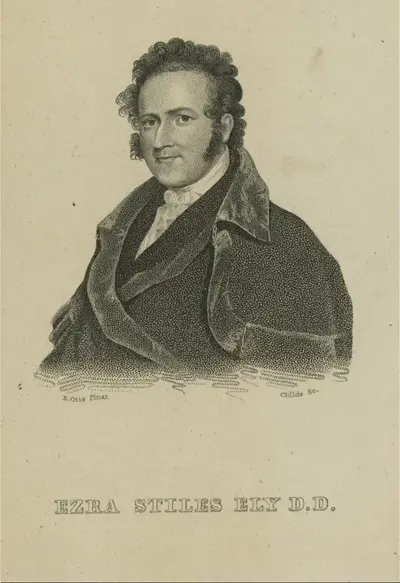
Ezra Stiles Ely was an American minister (Presbyterian) during the Second Great Awakening.
