Richard Southwell Bourke, 6th Earl of Mayo Quotes
Are the Indian Musalmans bound by their religion to rebel against the Queen?
Richard Southwell Bourke. Victoria was then Queen. The role of the Islamic religion in terms of violence, terrorism & rebellion is not uniquely a question of the 21st century. The 19th Century saw much Islamic fundamentalist violence in India and other Islamic Colonies—much more than from other religious groups in similar colonial status. Opinion was divided between those who saw Islam—especially the Wahabi sect—as inciting violence per se. Mayo assigned one of his administrators to do a study of the issue. See {616924} for the study of William Wilson Hunter. Ironically, Lord Mayo was stabbed to death in a terrorist attack on him personally in 1872.
Earl Mayo, 1822-1872, British Viceroy and Governor General of India, Question he posed to his administrators in the face of Moslem violence and terrorism.
Sourced by: Eigen's Political and Historical Quotations

The Western style of education was extremely effective for the Hindus, but was much less successful for the Muslims. The result was that over time, the Hundus achieved success in the professions, civil service, arts and sciences while the Muslims did not, thus changing the then existing parity of the two groups. For more on the difficulty that the Muslims had with British public education, see {616919} & {616925}.


This is one of the early calls for a partition of India which was to be so disastrous after the Second World War. The “free Muslim state of states” turned out to be Pakistan where they have been fighting amongst themselves about how much Sharia would prevail.

That is exactly what happened. However it would not happen until after the Second World War.


A fatwa is a religious legal ruling.
The Governor had introduced Sharia, Islamic Law, into his state. When a woman was sentenced to death by stoning, the Federal Government nullified the sentence on the ground that stoning was not morally right nor was a death penalty for her actions. The woman was not executed


Husayn Ali Nuri

His call for the Pope’s assassination in a public meeting produced counter-protests all over England. Choudary had earlier threatened British Jews. See {615445}.
A very passionate minority of India’s Muslims demanded a separate Islamic State (that would become Pakistan) but Hindu’s and Muslims were mixed throughout India and many Indians and British were concerned that there would be a bloodbath if the plans for independence went forward. When the decision had been made to partition India, Radcliffe had the unenviable task of deciding where the boundary was to be between Pakistan and India. No one on either side was satisfied with his effort. So, realizing that violence was about to break out, he packed quickly and went back to England. Over two million Indians were killed in the violence that broke out in the next weeks as there was a huge migration and ethnic cleansing to implement Radcliffe’s boundaries. Fifty years later, both India and Pakistan acknowledge that Radcliffe did a very reasonable job.
The problem was that the British had adopted an Indian Civil Service system and instituted an educational system to train Indians. The Hindus attended the schools and did very well on the examinations. The Muslims, however, resisted the secular education, and most of their young men could not pass the examinations. See {616924} & {616925}.
a political party. In the early days of the Muslim religion, the entire Middle East was under the authority of the Caliph who had both religious and civil authority—very much like the Pope did in Europe. However, corruption, independent tribes, feuds, and civil wars destroyed the Caliphate and there has been no common Islamic leader since. Some Muslims want to eradicate the individual countries and restore the Caliphate.


This particular quotation is very important. Khomeini was probably the most influential Muslim in the 20th Century. The fact that he wrote this in 1942—before there was an Israel as an enemy—shows how deep seated the requirement for world conquest is. To the Nazi’s world conquest was a justifiable goal. To Khomeini and his many followers, it is a religious obligation and duty and thus is every more dangerous. Extreme anti Muslims justify the attempted expulsion of Muslim immigrants on the grounds that they are a fifth column whose loyalty is and will be to the religion which will attempt to conquer their country. It gives Islamaphobia a veneer of respectability.
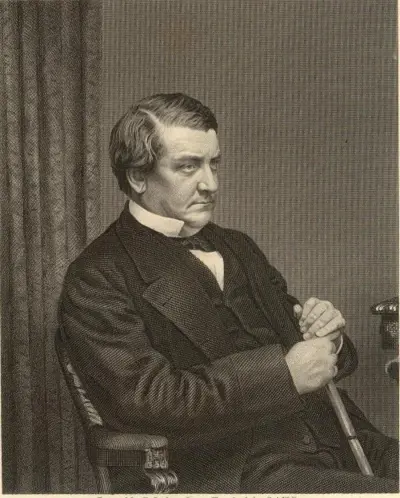
- Born: February 21, 1822
- Died: February 8, 1872
- Nationality: Irish
- Profession: Stateman
Richard Southwell Bourke, 6th Earl of Mayo, styled Lord Naas between 1842 and 1867, was a statesman and prominent member of the British Conservative Party from Dublin, Ireland.
