Charles A. Beard Quotes
If these precedents are to stand unimpeached, and to provide sanctions for the continued conduct of America affairs-the Constitution may be nullified by the President and officers who have taken the oath and are under moral obligation to uphold it....they may substitute personal and arbitrary government-the first principle of the totalitarian system against which it has been alleged that World War II was waged-while giving lip service to the principle of constitutional government.
Beard, Charles A. President Roosevelt and the Coming of the War, 1941: A Study in Appearances and Realities. Yale UP, 1948, p. 583.

Ashmun introduced this anti-war resolution during the Mexican War. This resolution failed, but Abraham Lincoln, then a Freshman Congressman voted for it

There have been many examples of Presidents in time of war who have asked Congress & received additional powers whose constitutionality was sometimes tested. The Alien & Sedition acts of the John Adams administration, Lincoln in the Civil War controlling the Southern governments, Wilson jailing people verbally opposing the draft, FDR incarcerating Japanese Americans in WWII. However, in those cases, the President asked for and got the powers from Congress. Nichols claimed that by Bush, just assuming powers, he was acting like a king & not a president, and that per se was an impeachable offence. As unpopular as Bush was, his Vice President was much moreso, & Bush was in his last term; neither party wanted to go through another impeachment after the Republican attempt to oust William Clinton ended in acquittal. Other constitutional scholars do not believe the “acting like a king” rises to the level of an impeachable offense; only specific “high crimes & misdemeanors” would qualify.


The United States government had for many years deposited all its funds in a single private bank, the Bank of the United States. In 1833, President Andrew Jackson, without any congressional authorization, ordered the federal deposits to be distributed among state banks instead. The Senate was furious and passed the first resolution of censure of a President in United States history:. Carried by a vote of 26 to 20. Four years later a pro-Jackson Senate majority voted to expunge the resolution.


The George W. Bush administration started a secret program to scan phone calls of Americans without a court order or a warrant in the midst of the War on Terror. New York Times uncovered the illegal program and then the President tried to justify it.
The Congress over the last century has ceded much of its Constitutional power to the President. Congress has much power to check the President, but just as Congress has not been very competent at legislating, oversight, and conducting hearings and investigations, it has not organized itself to use the powers it has very well.


In England, the King was above the law. However, impeachment was a tool that could be used against his favorite ministers. In debating the United State Constitution one of the first questions to be determined was whether impeachment could be a tool used against the President or like, England, only the other government officials. Franklin urged the President be included. See also Mason: {584246}.


Kors is paraphrasing Hayek and his book Road to Serfdom.


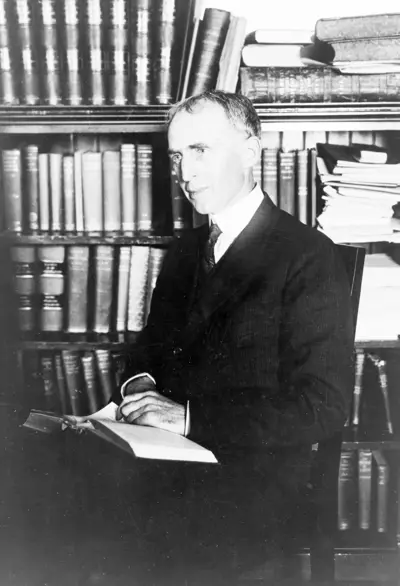
Charles Austin Beard was an American historian who wrote primarily during the first half of the 20th century. A history professor at Columbia University, Beard's influence is primarily due to his publications in the fields of history and political science. His works included a radical re-evaluation of the Founding Fathers of the United States, whom he believed to be more motivated by economics than by philosophical principles. Beard's most influential book, An Economic Interpretation of the Constitution of the United States (1913), has been the subject of great controversy ever since its publication. While it has been frequently criticized for its methodology and conclusions, it was responsible for a wide-ranging reinterpretation of American history of the founding era. He was also the co-author with his wife, Mary Beard, of The Rise of American Civilization (1927), which had a major influence on American historians.
