William Lloyd Garrison Quotes
If the State cannot survive the anti-slavery agitation, then let the State perish. If the Church must be cast down by the strugglings of Humanity to be free, then let the Church fall and its fragments be scattered to the four winds of Heaven, never more to curse the earth.
Garrison, William Lloyd. Selections from the Writings and Speeches of William Lloyd Garrison. R. F. Wallcut, 1852, p. 182.


Though Leo XIII was very much opposed to slavery, his claim that the Catholic Church “from the beginning” sought to end slavery overlooks the inconsistent reality of several of his predecessors’ teachings. For an example of this inconsistency one may find a relevant example as late as the 19th century, see the teachings of Gregory XVI {611428}, Pius IX {612304}, and Leo XIII {611844}

Fitzhugh was a Southern iconoclast whose view of Northern labor was much like that of Karl Marx but who was an enthusiastic supporter of slavery. Fitzhugh was of the opinion that slavery would be reinstated in the North and his treatise agues for that. More and more intellectual opinion was coming to the conclusion that slavery must be abolished or made universal before Lincoln’s famous statement in his debate against Douglas. Although Northerners and Southerners had come to agree on this point, they disagreed about which alternative would and should prevail.

This prophecy written in the later years of Jefferson’s life turned out to be all too true. St. Domingo was an Island in the Caribbean where slavery produced a bloody war. The American Civil War would be far worse.


While England was strongly opposed to slavery, the English textile industry benefited from importing American Southern cotton. So many in England were supportive of the Confederacy.


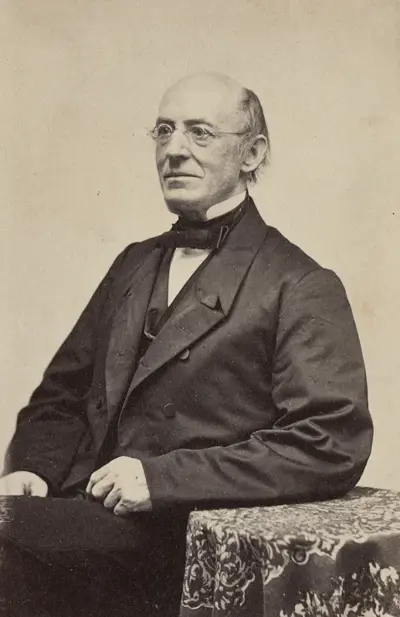
William Lloyd Garrison, who signed and printed his name Wm. Lloyd Garrison, was a prominent American abolitionist, journalist, suffragist, and social reformer. He is best known for his widely-read anti-slavery newspaper The Liberator, which he founded in 1831 and published in Boston until slavery in the United States was abolished by Constitutional amendment in 1865. He was one of the founders of the American Anti-Slavery Society, and promoted immediate and uncompensated, as opposed to gradual and compensated, emancipation of slaves in the United States.
