John Quincy Adams Quotes
Who but shall learn that freedom is the prize Man still is bound to rescue or maintain; That nature's God commands the slave to rise, And on the oppressor's head to break the chain. Roll, years of promise, rapidly roll round, Till not a slave shall on this earth by found.
Adams, John Quincy. Poems of Religion and Society. William H. Graham, 1848, p. 11.


Fitzhugh was a Southern iconoclast whose view of Northern labor was much like that of Karl Marx but who was an enthusiastic supporter of slavery. Fitzhugh was of the opinion that slavery would be reinstated in the North and his treatise agues for that. More and more intellectual opinion was coming to the conclusion that slavery must be abolished or made universal before Lincoln’s famous statement in his debate against Douglas. Although Northerners and Southerners had come to agree on this point, they disagreed about which alternative would and should prevail.

Ireland, a part of the British Empire, and ruled by the English monarch, had many who celebrated the French Revolution, even as the English Royalists, looked upon France in horror. What is interesting is that the Irish newspaper could actually publish opinions like this which could be argued were treasonous.


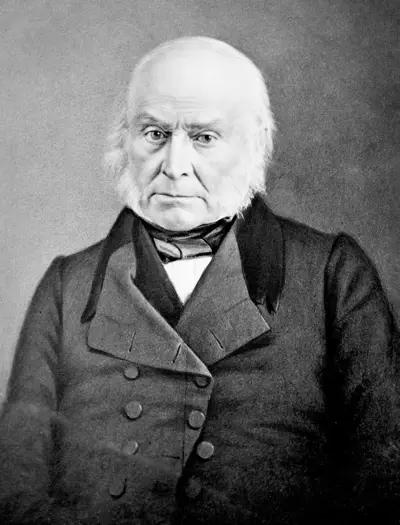
John Quincy Adams was an American statesman, diplomat, lawyer, and diarist who served as the sixth president of the United States, from 1825 to 1829. He previously served as the eighth United States Secretary of State from 1817 to 1825. During his long diplomatic and political career, Adams also served as an ambassador, and as a member of the United States Senate and House of Representatives representing Massachusetts. He was the eldest son of John Adams, who served as the second U.S. president from 1797 to 1801, and First Lady Abigail Adams. Initially a Federalist like his father, he won election to the presidency as a member of the Democratic-Republican Party, and in the mid-1830s became affiliated with the Whig Party.
