Harlan F. Stone Quotes
If a juror feels that the statute involved in any criminal offence is unfair, or that it infringes upon the defendant’s natural God-given unalienable or Constitutional rights, then it is his duty to affirm that the offending statute is really no law at all and that the violation of it is no crime at all, for no one is bound to obey an unjust law.
Harlan Fiske Stone, 1872-1946, Chief Justice of the U. S. Supreme Court, U. S. Attorney General (Republican), Quoted in “Jury Nullification And Bad DUI Law”, http://duiundoconsultants.wordpress.com/
Sourced by: Eigen's Political and Historical Quotations

This is a very important and fundamental quotation. Jefferson, John Adams, John Jay and many other Founding Fathers told us that the jury of peers was the final arbiter of a court case. However, many modern judges and legislatures have tried to erode that principle. In most states judges instructs juries that they are the final arbiter of the facts but he/she is the final arbiter of the law and how it should be applied in the case. But the founders wanted the jury to be the final arbiters of the law as well as the facts as is illustrated here and in {640588} and {640589}. For a more modern concurring view, see {640590}

This is a very important and fundamental quotation. Jefferson, John Adams, John Jay and many other Founding Fathers told us that the jury of peers was the final arbiter of a court case. However, many modern judges and legislatures have tried to erode that principle. In most states judges instructs juries that they are the final arbiter of the facts but he/she is the final arbiter of the law and how it should be applied in the case. But the founders wanted the jury to be the final arbiters of the law as well as the facts as is illustrated here and in {640587} and {640589}. For a more modern concurring view, see {640590}.
This principle that the jury may, if it chooses, decide on the law and not neccessarily follow the Judges instructions on the law was held by John Adams and John Jay, the first Chief Justice of the Supreme Court, as well as political and judicial leaders throughout American History. But in the 20th century the Judiciary and many legeslatures has tried to restrict taht freedom of the Juries. At the beginning of the 21st Century, the only state whose laws explictly followed that practice was Maryland, and even there, very few judges ever informed juries that they could override or ignore him on matters of law.

Note the use of the phrase “against the government.” One of the unique aspects of the American Constitution and The Bill of Rights is that the government is considered a potential and even probable infringer on the liberties of the people. It is almost as though the government was the potential enemy. Modern libertarians state this very explicitly and it is ever present in the views of both the right and left wings of American politics. Most centrists recoil at the thought that some citizens see the government as the enemy, but even in America there have been times where the government has infringed on the rights of citizens only to have the courts or future administrations and Congresses correct the error.


On the Fugitive Slave Act: As one of the leading American Catholic intellectuals during the 19th Century, Brownson’s opinions went far in keeping Catholics from joining the side of the abolitionists. However, just a few years later his tone would change and he would become one of the few Catholic writers to refuse to defend slavery, see {610710}. While the majority of Catholics refused to join the abolition movement, they often did so because abolitionism was closely tied to anti-Catholicism, see Gordon {611392} or Shaftesbury {611106}. Other reasons included Irish immigrants fearful of competition from Black labor and the fear of liberal individualism and social disorder, which was prevalent in 19th century Catholic thought. For a further explanation on the relationship between American Catholics and slavery, see McGreevy {612036}.


Hayward claimed that Wilson was the first American President who ever criticized the American Constitution. Many do not agree as Madison and Jefferson in part, along with most other Americans, found the Constitution so wanting that it was ratified only on condition of the passage of the Bill of Rights. Jackson, was distressed by the limitations on the President and many others had their objections, but Wilson, before he became a politician was a prominent academic political scientist and wrote voluminously and had an intellectual following so his criticism was not considered so “political” as others.


Ever since that decision was written, lawmakers, judges and attorneys have worked very hard to minimize its impact and allow the jury to only decide on the facts and not the law. Only Maryland today preserves the right of the jury to decide what the law means and to judge it. Authorities, even democratic ones, do all they can to prevent what is called “jury nullification”. Regardless, juries often exercise that right regardless of the judge’s instructions.


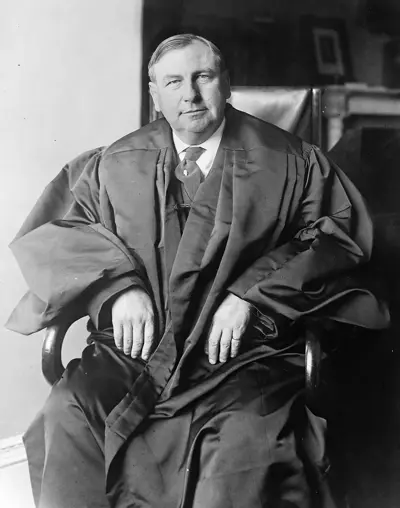
- Born: October 11, 1872
- Died: April 22, 1946
- Nationality: American
- Profession: Lawyer
Harlan Fiske Stone was an American lawyer and jurist who served as an Associate Justice of the U.S. Supreme Court from 1925 to 1941 and then as the Chief Justice of the United States from 1941 until his death in 1946. He also served as the U.S. Attorney General from 1924 to 1925 under President Calvin Coolidge, with whom he had attended Amherst College as a young man. His most famous dictum was: "Courts are not the only agency of government that must be assumed to have capacity to govern."
