John Jay Quotes
The jury has the right to judge both the law as well as the fact in controversy
Ever since that decision was written, lawmakers, judges and attorneys have worked very hard to minimize its impact and allow the jury to only decide on the facts and not the law. Only Maryland today preserves the right of the jury to decide what the law means and to judge it. Authorities, even democratic ones, do all they can to prevent what is called “jury nullification”. Regardless, juries often exercise that right regardless of the judge’s instructions.
John Jay, 1745-1829, President of the Continental Congress, Governor of New York (Federalist), U.S. Foreign Secretary, First Chief Justice of the U. S. Supreme Court, Georgia v. Brailsford, 1794
Sourced by: Eigen's Political and Historical Quotations


This principle that the jury may, if it chooses, decide on the law and not neccessarily follow the Judges instructions on the law was held by John Adams and John Jay, the first Chief Justice of the Supreme Court, as well as political and judicial leaders throughout American History. But in the 20th century the Judiciary and many legeslatures has tried to restrict taht freedom of the Juries. At the beginning of the 21st Century, the only state whose laws explictly followed that practice was Maryland, and even there, very few judges ever informed juries that they could override or ignore him on matters of law.


This is a very important and fundamental quotation. Jefferson, John Adams, John Jay and many other Founding Fathers told us that the jury of peers was the final arbiter of a court case. However, many modern judges and legislatures have tried to erode that principle. In most states judges instructs juries that they are the final arbiter of the facts but he/she is the final arbiter of the law and how it should be applied in the case. But the founders wanted the jury to be the final arbiters of the law as well as the facts as is illustrated here and in {640587} and {640589}. For a more modern concurring view, see {640590}.


This quotation is a great example of the difficulty of deciding some of the major Constitutional issues. Most reasonable people believe that Rehnquist certainly has a point. On the other hand, critics observe that this quotation essentially says that it is OK to convict an innocent person if it cost too much or be too much trouble to do so. Reasonable people would also agree that this objection has much merit also. So the judicial system is stuck with deciding when the cost or trouble is too much. There will never, can never, be a clear cut answer.

This is a very important and fundamental quotation. Jefferson, John Adams, John Jay and many other Founding Fathers told us that the jury of peers was the final arbiter of a court case. However, many modern judges and legislatures have tried to erode that principle. In most states judges instructs juries that they are the final arbiter of the facts but he/she is the final arbiter of the law and how it should be applied in the case. But the founders wanted the jury to be the final arbiters of the law as well as the facts as is illustrated here and in {640588} and {640589}. For a more modern concurring view, see {640590}


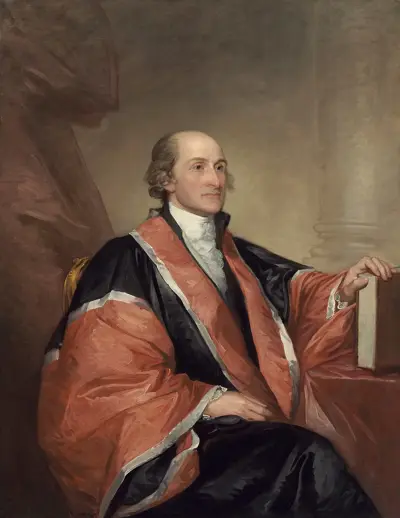
John Jay was an American statesman, patriot, diplomat, Founding Father, abolitionist, negotiator, and signatory of the Treaty of Paris of 1783. He served as the second Governor of New York and the first Chief Justice of the United States (1789–1795). He directed U.S. foreign policy for much of the 1780s and was an important leader of the Federalist Party after the ratification of the United States Constitution in 1788.
