Oliver Wendell Holmes Jr. Quotes
The jury has … the power to bring in a verdict in the teeth of both law and facts.
Oliver Wendell Holmes Jr., 1841-1935, U. S. Supreme Court Justice, Horning v D.C., 1920
Sourced by: Eigen's Political and Historical Quotations


This is a very important and fundamental quotation. Jefferson, John Adams, John Jay and many other Founding Fathers told us that the jury of peers was the final arbiter of a court case. However, many modern judges and legislatures have tried to erode that principle. In most states judges instructs juries that they are the final arbiter of the facts but he/she is the final arbiter of the law and how it should be applied in the case. But the founders wanted the jury to be the final arbiters of the law as well as the facts as is illustrated here and in {640588} and {640589}. For a more modern concurring view, see {640590}

This principle that the jury may, if it chooses, decide on the law and not neccessarily follow the Judges instructions on the law was held by John Adams and John Jay, the first Chief Justice of the Supreme Court, as well as political and judicial leaders throughout American History. But in the 20th century the Judiciary and many legeslatures has tried to restrict taht freedom of the Juries. At the beginning of the 21st Century, the only state whose laws explictly followed that practice was Maryland, and even there, very few judges ever informed juries that they could override or ignore him on matters of law.

Ever since that decision was written, lawmakers, judges and attorneys have worked very hard to minimize its impact and allow the jury to only decide on the facts and not the law. Only Maryland today preserves the right of the jury to decide what the law means and to judge it. Authorities, even democratic ones, do all they can to prevent what is called “jury nullification”. Regardless, juries often exercise that right regardless of the judge’s instructions.


This is a very important and fundamental quotation. Jefferson, John Adams, John Jay and many other Founding Fathers told us that the jury of peers was the final arbiter of a court case. However, many modern judges and legislatures have tried to erode that principle. In most states judges instructs juries that they are the final arbiter of the facts but he/she is the final arbiter of the law and how it should be applied in the case. But the founders wanted the jury to be the final arbiters of the law as well as the facts as is illustrated here and in {640587} and {640589}. For a more modern concurring view, see {640590}.

Many of our Founding Fathers held the view that the Jurors should decide not only about the facts but also they have the final decision on the law. The concept of the jury not following the judge’s interpretation and instructions as to the law is called Jury Nullification of which many of the founders approved. In modern times however, most states require the jury to accept the judge’s instructions as to the law, and the Jury’s only role is to decide on the facts. Maryland is the only state left which allows the jury to make the final decision on the law as well as the facts. However, many jurors will silently nullify the Judges instructions and vote accordingly as jurors need not explain their reasoning in most jurisdictions. See {641742}, {590841}, {591140} & {591139} for similar views by other Founding Fathers.


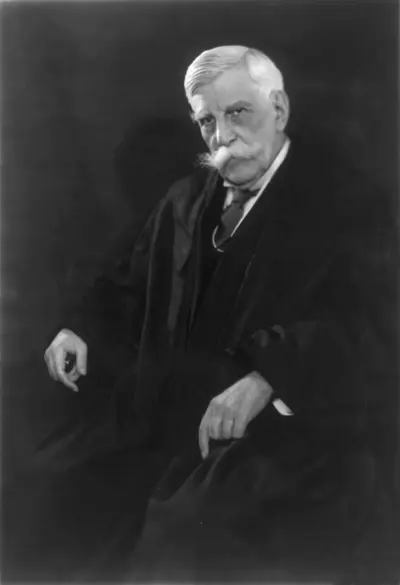
Oliver Wendell Holmes Jr. was an American jurist who served as an Associate Justice of the Supreme Court of the United States from 1902 to 1932. Noted for his long service, concise and pithy opinions, and deference to the decisions of elected legislatures, he is one of the most widely cited United States Supreme Court justices in history, particularly for opinions on civil liberties and American constitutional democracy, and is one of the most influential American common law judges, honored during his lifetime in Great Britain as well as the United States. Holmes retired from the court at the age of 90, an unbeaten record for oldest justice in the federal Supreme Court (although John Paul Stevens was only 8 months younger when he retired on April 12, 2010). He previously served as an Associate Justice and as Chief Justice of the Massachusetts Supreme Judicial Court, and was Weld Professor of Law at his alma mater, Harvard Law School.
