Fidel Castro Quotes
I would not vote for the mayor. It's not just because he didn't invite me to dinner, but because on my way into town from the airport there were such enormous potholes.
Castro, Fidel. Address to the Abyssinian Baptist Church. Harlem, New York, 22 Oct. 1995.


Norquist was a modern day Party Boss. He controlled a number of large PACS conservative lobbyists. His “issue” at the time was that no one should allow Congress to do anything unless it was agreed that under no circumstances that would there be taxes of any kind passed and no tax loopholes would be closed. He required Republican candidates and members to sign a pledge before he would give them any campaign money. About 90% did. A generally agreed bad law was a tax subsidy for farmers who grew corn for ethanol. Most Americans wanted to repeal it. Norquist sent letters to the Republicans telling them that voting for repeal was ok and he would not see it as violating their pledge. See Norquist’s response {623265} .
Actually, Clinton was historically wrong. There have been several occasions in American history where an unelected party boss was able to control and veto the Congressional actions of members of their own party. However. The earlier occasions were in the 19th century—Norquist was the first of the party bosses to amass that kind of control in modern times.


This was one of the early suggestions for providing jobs for the unemployed to work at developing the national infrastructure. In this case if highways and the river could be improved, transportation would allow goods to be reach more of the country cheaper. The CCC and the Job Corps of America would use a similar reasoning for public employment.


At the time, roads were built by the states. This was one of the first instances urging that the Federal Government take some responsibility for roads. This would culminate when President Eisenhower proposed and created the National Highway System and as Madison predicted, it would have a massive economic benefit for the nation.

It was on time and on budget. It is hard to imagine that we could complete a project this large today. It would take more than 8 years to do the studies and get the permits and fight off the lawsuits. However, the engineering feat for the up and coming young country was as Clinton said, “unparalleled in the experience of mankind.” America had already exceeded the Ancient Egyptians, the Europeans, the Chinese. The economic development for the young nation was enormous—as big as the digital revolution almost two centuries later.

FDR had envisioned a national highway system. He had taken a map of the United States and drew three horizontal lines across the country and another three vertical lines running North to South. These he envisioned as a national highway system. The Second World War intervened with all men and material devoted to the war effort, highway ideas were all on the back burner. After the war President Dwight Eisenhower, in one of the great presidential achievements of American history, initiated the Federal National Highway System. The main difference was a reversal of the classic party positions. Democrat Roosevelt had planned to have the users pay for much or part of the construction and maintenance, while Republican Eisenhower accepted the entire burden on the general taxpayers and tolls and usage fees were banned on Federal Highways.


Marie Joseph Paul Yves Roch Gilbert du Motier


In the beginning of the 21st century governments with large financial resources developed many buildings and communities as did in some capitalistic countries private firms. Many were successful but there were some failures almost everywhere. However after the Meltdown of 2008 and the Great Recession many large buildings and communities the world over were under-utilized and in many cases not used at all. Proportionately, Ireland, Spain and Greece had the worst problem (public as well as provate). However just because of size and wealth, the United States and China had the most unused buildings and communities that were developed. However, many economists and developers argue that even of those projects were failures, the buildings, streets, sewers, utilities and infrastructure will be there and when the economy heats up, they will be used.


John Purroy Mitchell, 1879–1918, was an abject failure as a mayor. He only lasted one term and almost had a popular revolution against him. He had no ability to connect with the average voter and cared little for any but the upper classes, many of whom lived on 5th Avenue. 1st Avenue in contrast was full of overcrowded slums and the poorest people in the city. His repugnance for common people was ironic because he was the grandson of the great Irish nationalist, John Mitchel, 1815-1874, Irish Journalist & Founder of United Irishman and Founder of The Irish Confederation. He was one of the great heroes of the common people who was jailed in Australia by the English. He escaped and came to New York City.

Republican members of Congress have been publicly calling Democratic Presidents nasty names at several times in History. When President Barack Obama was called a liar at his State of the Union Message, to most people’s shock and distaste, it was following a history of such insulting behavior. In this instance, everything that FDR had predicted for the Dam turned out to be not only true but was an understatement of the economic benefit. It was finished just in time to power the new Aluminum industry that made all the super-bombers and 750 major ships in WWII. Congressman Kulkin was a minor figure in American history who never accomplished much as a Congressman other to insult the President and question his motives.

Responding to criticism of his flamboyant personal lifestyle:
See {642230} for has additional views on German leadership. Many serious Germans agreed but the culture, concept of patriotism, and the laws did not encourage open discussion of negative things about the nation.

Although Madison vetoed the Federal bill to improve the national infrastructure, he was very much for the improvements and he said so in this veto message. He, however, did not see the Constitutional authority for the Federal government to appropriate moneys to be spent in the States for infrastructure improvement. He was for a Constitutional Amendment to do so or to make the improvements using State money as New York did building the Erie Canal. Alexander Hamilton, and many of the Congressmen who voted for the bill disagreed (many of whom were also in the Constitutional Convention) and did not see the Constitutional limitation that Madison did. See Hamilton’s Quote 644278. He was particularly concerned that small and less affluent states could not possibly have the skill to design these or the finances to build them. Later President’s and Congresses sided with Hamilton. It would be hard to envision America today of Madison’s view had prevailed.

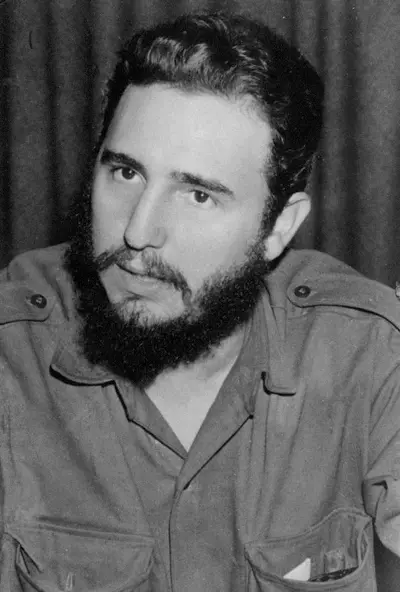
Fidel Alejandro Castro Ruz better known internationally as Fidel Castro, was a Cuban revolutionary and politician who served as Prime Minister of Cuba from 1959 to 1976 and President from 1976 to 2008. Ideologically a Marxist–Leninist and Cuban nationalist, he also served as the First Secretary of the Communist Party of Cuba from 1961 until 2011. Under his administration, Cuba became a one-party communist state; industry and business were nationalized, and state socialist reforms were implemented throughout society.
