Robert Byrd Quotes
Potholes know no party.
Robert Byrd, 1917-2010, U. S. Congressman & U. S. Senator (Democrat, WV), Senate Majority & Minority Leader, 1987
Sourced by: Eigen's Political and Historical Quotations


Nagin was being aggressively questioned about why New Orleans was not rebuilt from the destruction of Hurricane Katrina. He gave as an example the fact that the World Trade Center site in New York had not even started with any rehabilitation. The politics of rebuilding after a catastrophe have become very complicated regardless of the location. Many in New York found the wording “hole in the ground” insensitive as 2,000 people had died on the site. The reality is that both rebuilding efforts were severely hampered by political issues: In the case of New York, the kind of memorial that would be appropriate for “hallowed ground.” In New Orleans, the issues of rebuilding in risky area vs more protection was debated as well as the racial effect where New Orleans had been a majority Black city before but depending on how it was rebuilt might not be after.


The King, visiting Washington and hosted by the Senate Foreign Relations Committee, was asked his opinion by Senator Clifford Case on an issue that was quite partisan.

At the time, roads were built by the states. This was one of the first instances urging that the Federal Government take some responsibility for roads. This would culminate when President Eisenhower proposed and created the National Highway System and as Madison predicted, it would have a massive economic benefit for the nation.

It was on time and on budget. It is hard to imagine that we could complete a project this large today. It would take more than 8 years to do the studies and get the permits and fight off the lawsuits. However, the engineering feat for the up and coming young country was as Clinton said, “unparalleled in the experience of mankind.” America had already exceeded the Ancient Egyptians, the Europeans, the Chinese. The economic development for the young nation was enormous—as big as the digital revolution almost two centuries later.
This section of the message was all about the Erie Canal that was under construction. Note that unlike today, where interest in public works and development is so localized, Clinton was extolling the virtue of developing the economy of the region and the nation. The money was all New York State money. The Federal Government would not fund the Erie Canal as they did not believe it was technically feasible to construct. See {624484} . Patriotism had a different meaning then.

FDR had envisioned a national highway system. He had taken a map of the United States and drew three horizontal lines across the country and another three vertical lines running North to South. These he envisioned as a national highway system. The Second World War intervened with all men and material devoted to the war effort, highway ideas were all on the back burner. After the war President Dwight Eisenhower, in one of the great presidential achievements of American history, initiated the Federal National Highway System. The main difference was a reversal of the classic party positions. Democrat Roosevelt had planned to have the users pay for much or part of the construction and maintenance, while Republican Eisenhower accepted the entire burden on the general taxpayers and tolls and usage fees were banned on Federal Highways.
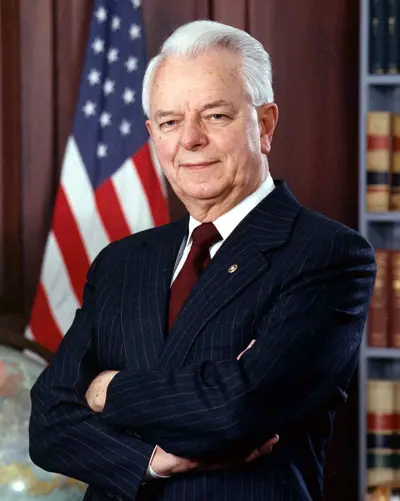
Robert Carlyle Byrd was an American politician who served as a United States Senator from West Virginia for over 51 years, from 1959 until his death in 2010. A member of the Democratic Party, Byrd also served as a U.S. Representative for six years, from 1953 until 1959. He remains the longest-serving U.S. Senator in history; he was the longest-serving member in the history of the United States Congress until surpassed by Representative John Dingell of Michigan. He was the last remaining member of the U.S. Senate to have served during the presidency of Dwight Eisenhower, and he was the last remaining member of Congress to have served during the presidency of Harry S. Truman. Byrd is also the only West Virginian to have served in both chambers of the state legislature and both chambers of Congress.
