Theodore Roosevelt Quotes
Mayor Mitchel has too much 5th Avenue and not enough 1st Avenue.
John Purroy Mitchell, 1879–1918, was an abject failure as a mayor. He only lasted one term and almost had a popular revolution against him. He had no ability to connect with the average voter and cared little for any but the upper classes, many of whom lived on 5th Avenue. 1st Avenue in contrast was full of overcrowded slums and the poorest people in the city. His repugnance for common people was ironic because he was the grandson of the great Irish nationalist, John Mitchel, 1815-1874, Irish Journalist & Founder of United Irishman and Founder of The Irish Confederation. He was one of the great heroes of the common people who was jailed in Australia by the English. He escaped and came to New York City.
Theodore Roosevelt, 1858-1919, 26th President of the United States (Republican, NY), Criticism of New York Mayor, 1914, Quoted by Thai Jones, “New York’s Year of Anarchy”, C-SPAN American History TV, January 29, 2014
Sourced by: Eigen's Political and Historical Quotations


I may not know how to tune a lyre, but I know all that I need to know to make a city great and free.
Themistocles was not of an upper class family and did not have many of the typical social graces of the time. However he did not worry about that and became the victorious admiral over the Persians and Archon of Athens which made him the leader of all the Greeks. He however grew unpopular over time and was voted to be banished which he was.


Nagin was being aggressively questioned about why New Orleans was not rebuilt from the destruction of Hurricane Katrina. He gave as an example the fact that the World Trade Center site in New York had not even started with any rehabilitation. The politics of rebuilding after a catastrophe have become very complicated regardless of the location. Many in New York found the wording “hole in the ground” insensitive as 2,000 people had died on the site. The reality is that both rebuilding efforts were severely hampered by political issues: In the case of New York, the kind of memorial that would be appropriate for “hallowed ground.” In New Orleans, the issues of rebuilding in risky area vs more protection was debated as well as the racial effect where New Orleans had been a majority Black city before but depending on how it was rebuilt might not be after.

Although Fiorello La Guardia proposed an aggressive reform program for New York City, he did not go far enough for some.


This famous charity political dinner is annually attended by the very wealthy. While the Republican party at this time had the wealthy as one of its constituents, it had been considered politically tactful not to make public statements about the party and the wealthy. Bush was not very tactful and the quotation was widely circulated to middle class and poor citizens who resented Bush’s point of view and his wording using “haves” and “have-mores” Others appreciated the humor.

Referring to President Ronald Reagan whose administration was very good for the wealthy and the large corporations but economically was the start of a downward spiral in the income of the lower middle and lower classes of the society. Reagan and many politicians of both parties were often oblivious to the lives of people not in the upper strata of society. It was not so much that they were against the middle class and poor; they just did not have much contact with them and their plight was list in the averaging of economic statistics that showed increasing income.


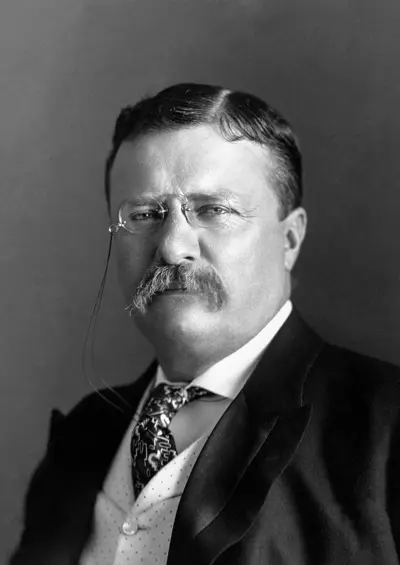
Theodore Roosevelt Jr., often referred to as Teddy or his initials T. R., was an American statesman, conservationist, naturalist, historian, and writer, who served as the 26th president of the United States from 1901 to 1909. He previously served as 33rd governor of New York from 1899 to 1900 and the 25th vice president of the United States from March to September 1901. Roosevelt emerged as a leader of the Republican Party and became a driving force for anti-trust and Progressive policies.
