Nathaniel Hawthorne Quotes
I shall not pretend to be an admirer of old John Brown any farther than sympathy with Whittier's excellent ballad about him may go; nor did I expect ever to shrink so unutterably from any apothegm of a sage, whose happy lips have uttered a hundred golden sentences, as from that saying, (perhaps falsely attributed to so honored a source,) that the death of this blood-stained fanatic has "made the Gallows as venerable as the Cross!" Nobody was ever more justly hanged. He won his martyrdom fairly, and took it firmly.
Nathaniel Hawthorne, 1804-1864, Writer, View of John Brown, “Chiefly About War Matters”, The Atlantic Monthly, July 1862
Sourced by: Eigen's Political and Historical Quotations

John Brown, in a futile effort to start a slave insurrection, raided the arsenal at Harper’s Ferry. His raid failed and he was captured and hanged. However, he became a martyr to the abolitionist movement, and his death is still sung of gloriously to this day. See {584889} and {604003}.


“Captain Brown” referred to the radical abolitionist, John Brown, 1800-1859, who was then about to be executed for his violent abolitionist activities in attacking the military arsenal at Harper’s Ferry and planning to arm slaves for a slave revolt. His view of revenge was to eliminate slavery. Note that he was a moral sympathizer of Brown. See {633849}.


Wilberforce was one of the early staunch opponents of slavery.


When the Confederate Government realized that the Union was planning to arm escaped slaves and induct them into the Union Army, they quickly passed a law that declared any escaped slave who joined the Union Army or wore its uniform was guilty of Treason and would be executed. Most Union Generals one way or another got word to the Confederate Officers that they had better treat all Negro Union Soldiers as prisoners of war. Even President Lincoln warned the South. Butler, however, had a large number of Negro troops in his area and had heard threats of some of the Southerners to execute Black prisoners of war. He had a way of making things very clear, and he was able to prevent murder of any of his Negro troops despite the Treason law.

He was a very large, heavy set man, and he wanted the Turk to know that he had strong connections in America. The Turks had made the mistake of allying themselves with Germany in WWI, but as thinks were not going very well for the Germans in the war, the Turkish leadership did not want to needlessly offend the United States. Aaronsohn was not hanged.


Andrew had actually contributed money to Brown’s movement. This quotation is a wonderful illustration of the schism that existed in pre-Civil War America. Brown had just led an armed attack on a Federal Facility, been tried and executed. Imagine sympathy and justification for such an act by a leading politician in modern times.


Servetus’ book On the Motion of the Heart and Blood of Animals, was so threatening that of the 1000 copies that were printed only 3 survived the burning including ironically Calvin’s personal marked up copy.


Louis Eugene Walcott. Malcolm X had criticized Elijah Mohammed for sexual behavior with staff.

Douglass tried to talk Brown out of what Douglass thought would be a suicide raid. Douglass was right.

The “stake” refers to burning at the stake, one of the methods of murder used in the South to intimidate Negroes and whites who might hold anti-slavery sentiments.


Nathaniel Gordon was the first American slave trader to be executed after the slave trade was made illegal. The Erie was his slave ship where, as was typical, many of the captured Blacks, died as a result of the inhuman conditions. Although Gordon was the first person executed in America, the act making the slave trade an act of piracy dated from 1820. See {68753} .


This is a very important quotation historically. There are a few historians and many politicians who claim that the rebellion of the South in the Civil War was motivated by a number of principles having little or nothing to do with slavery, while most historians have found that slavery was the only major issue. This quote further supports that view. This is the only Union General Officer would be executed if captured by the South. What crimes did he perform to warrant such exceptional treatment? He issued an order Emancipating the Slaves of the Southern Department of which he was the Commanding General. See {619331} . Lincoln quickly countermanded the order, but the act of freeing slaves was to the Southern government so heinous that it deserved the death penalty.
When the first Southern States seceded, each appointed a whose job it was to persuade the other Southern States to also secede. In this case Hale was marketing secession to Kentucky which with Maryland were the only two Southern States to reject what they regarded as treason and rebellion. The importance of the quotation however is in his argument which was all based on enmity to racial equality and abolition. Later Southern apologists would argue that the Civil War was fought, not about slavery and racism butt about different philosophies of government. See {623715} .
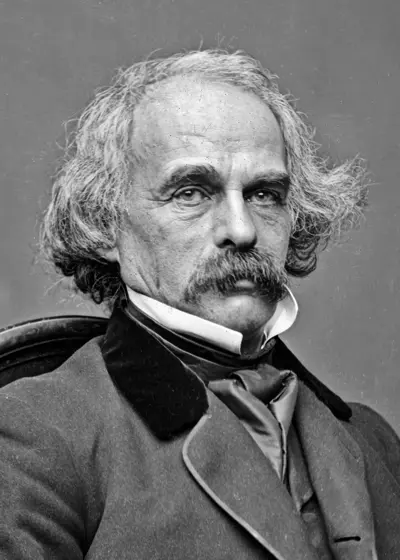
Nathaniel Hawthorne was an American novelist, dark romantic, and short story writer. His works often focus on history, morality, and religion.
