John Albion Andrew Quotes
John Brown was right, because he denied the validity of unrighteous and tyrannical enactments, and maintained the supremacy and binding obligation of the 'Higher Law.' John Brown was right, in all that he did--in his spirit and object, in his measures and warlike instruments … if Washington and Hancock and Warren were right--if Putnam, and Prescott, and the soldiers under them, on Bunker Hill, were right--if the Revolutionary struggle was right--if Wallace, and Tell, and Wrinkelreid, and Leonidas were right, in resisting tyranny unto blood!
Andrew had actually contributed money to Brown’s movement. This quotation is a wonderful illustration of the schism that existed in pre-Civil War America. Brown had just led an armed attack on a Federal Facility, been tried and executed. Imagine sympathy and justification for such an act by a leading politician in modern times.
John Albion Andrew, 1818-1867, Governor of Massachusetts, Reaction to John Brown’s Execution
Sourced by: Eigen's Political and Historical Quotations


“Captain Brown” referred to the radical abolitionist, John Brown, 1800-1859, who was then about to be executed for his violent abolitionist activities in attacking the military arsenal at Harper’s Ferry and planning to arm slaves for a slave revolt. His view of revenge was to eliminate slavery. Note that he was a moral sympathizer of Brown. See {633849}.

This quotation is historically important because Davis clearly states the reason for the rebellion of the South. The anti-slave states were growing at a greater rate than the slave states and despite the greater voting power that a southerner had (a result of the 3/5 count of slaves for census purposes, and the Senate), the handwriting was on the wall and the majority of the United States was against the vicious institution of slavery and would make it unprofitable, impossible and/or illegal in the coming years. Southern slavery advocates saw this as a “tyranny of the majority” and therefore took up arms. In the early 20th century, apologists for the Southern rebellion tried to promote the idea that there were reasons other than slavery, but this quotation and the resolutions of the states who withdrew from the Union make it clear that the right to maintain slavery was the only significant issue. In that sense it was a States’ Rights issue, but the South was opposed to States’ Rights when it came to States refusing to return fugitive slaves when Federal Law required such under the Dred Scott Supreme Court Decision.


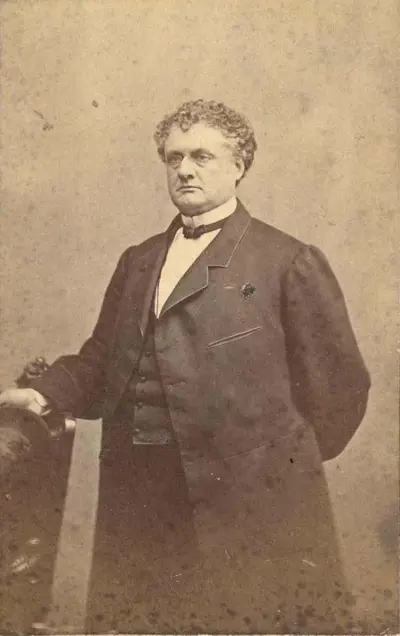
John Albion Andrew was an American lawyer and politician from Massachusetts. He was elected in 1860 as the 25th Governor of Massachusetts, serving between 1861 and 1866, and led the state's contributions to the Union cause during the American Civil War (1861-1865). He was a guiding force behind the creation of some of the first African-American units in the United States Army, including the 54th Massachusetts Infantry.
