Wilhelm II, German Emperor Quotes
I shall certainly do all in my power to keep Europe quiet and also guard the rear of Russia so that nobody shall hamper your action towards the Far East! For that is clearly the great task of the future for Russia to cultivate the Asian Continent and to defend Europe from the inroads of the Great Yellow race.
The two were cousins. Wilhelm was a very dominant personality and his cousin quite weak. This quotation shows the tyrannical view of the German Kaiser. The letters were secret but after the execution of the Czar, the Russians released the letters to show the dominant and warlike history of Germany under the Kaiser who was furious that the Russians had made such personal and secret letters public. Russia was involved with the Russo-Japanese war. Both the Russian and German aristocracies had designs on dominating Asia for the memories of the Asian invasions of Europe were still alive.
Wilhelm II, 1859-1941, Emperor of Germany & King of Prussia, Letter to Czar Nicholas of Russia, April 16, 1895
Sourced by: Eigen's Political and Historical Quotations

The issue of unilateral or multilateral foreign policy efforts faced America after WWII.

He had just returned from a trip abroad.

Some historians believe that with this quotation, Japan perceived that it had a “green light” from America to dominate Asia. It was further reinforced when Roosevelt later refused to object or intervene when Japan seized control of Korea.

This resolution was bad enough for its overt racism. Ironically, the major victims of Japanese aggression have been Asians—China, Korea, Manchuria, and others. “White” empires had economic interests in throughout Asia and this was what Britten and many others were concerned with protecting. This quotation is important for another reason. At the very moment Britton introduced the resolution, Charles Evans Hughes our Secretary of State was welcoming a new, very high level ambassador to Washington. The administration had decided on a negotiating initiative and Britton and other Congressmen cut the legs out from under the administrations diplomatic efforts. It was particularly bad because one of the Japanese complaints about America and other white nations was their racism and discrimination against Asians. Congress undermining Administration diplomatic efforts has an all too frequent history in America.

Meiji the Great


Germany had been Turkey’s traditional ally so this was another of his radical changes—tilting toward Britain.


The two were cousins. Wilhelm was a very dominant personality and his cousin quite weak. This quotation shows the egomaniacal view of the German Kaiser. The letters were secret but after the execution of the Czar, the Russians released the letters to show the dominant and warlike history of Germany under the Kaiser who was furious that the Russians had made such personal and secret letters public.

At the time, the major European countries were in a competitive scramble for colonies in Africa—so much so that there were very few independent territories left. The maps and borders of Africa were really decided by the Europeans.
This quotation shows that the racism and master race of Nazi Germany was a norm in Germany well before Adolf Hitler and the Nazis. It was an endemic part of the culture. This makes the German post WWII reforms all the more remarkable as the vast majority of an entire nation had to radically change its world and personal views and perceptions.


A few months later, that is exactly what Germany did. She was hoping that England would not enter the war despite her treaty obligations, but she was willing to risk the possibility. The Czar had a strong espionage and intelligence service active in Germany, but, like so many other intelligence failures, the intelligence operatives and analysts had military and economic facts but had little understanding of the German culture which propelled Germany to what to most other cultures was “irrational policy making.” People and nations often engage in irrational activities, even against their own self-interest.


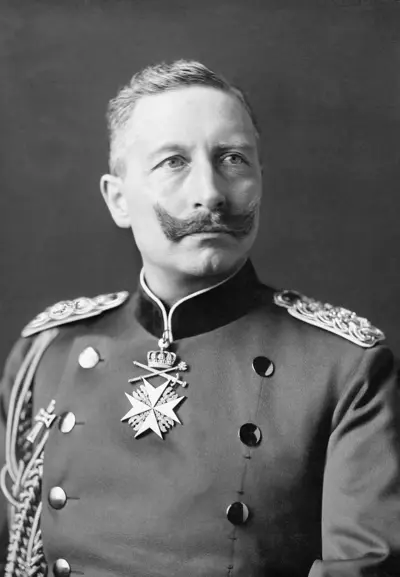
Wilhelm II, anglicised as William II, was the last German Emperor (Kaiser) and King of Prussia, reigning from 15 June 1888 until his abdication on 9 November 1918. Despite strengthening Germany's position as a great power by building a blue-water navy and promoting scientific innovation, his tactless public statements greatly antagonized the international community and his foreign policy was seen by many as one of the causes for the outbreak of World War I. When the German war effort collapsed after a series of crushing defeats on the Western Front in 1918, he was forced to abdicate, thereby bringing an end to the three-hundred-year rule of the House of Hohenzollern.
