Mutsuhito Meiji Quotes
The integrity of Korea is a matter of gravest concern to this Empire.... the separate existence of Korea is essential to the safety of our realm ... the absorption of Manchuria by Russia would render it impossible to maintain the integrity of China, and would, in addition, compel the abandonment of all hope for peace in the Extreme East .
Meiji the Great
Mutsuhito Meiji, 1852-1912, Emperor of Japan Declaration of War on Russia, February 10, 1904
Sourced by: Eigen's Political and Historical Quotations


The two were cousins. Wilhelm was a very dominant personality and his cousin quite weak. This quotation shows the tyrannical view of the German Kaiser. The letters were secret but after the execution of the Czar, the Russians released the letters to show the dominant and warlike history of Germany under the Kaiser who was furious that the Russians had made such personal and secret letters public. Russia was involved with the Russo-Japanese war. Both the Russian and German aristocracies had designs on dominating Asia for the memories of the Asian invasions of Europe were still alive.

Mobutu with Amerucan CIA and French assistance deposed Lumumba, murdered him, and seized power.


This was the 14th part of the Japanese reply to a previously made American peace proposal. The Japanese policy was to unite all of Asia into a co-prosperity sphere controlled by Japan where Japan would militarily conquer those Asian countries which did not “voluntarily” want to join. The Japanese were in the process of conquering China and the United States and Britain had embargoed oil and other material to Japan trying to pressure them to withdraw their troops from China and cease Japanese conquest by force. Japan believed that it was their right to conquer and control Asia and it was beneficial to the region, and that the U. S. and Britain had no right to curtail the expansion that Japan required to assure raw materials and other necessities. At the very time that these negotiations were on going, the Japanese fleet was sailing for the sneak attack on Pearl Harbor. The attack took place the very day this part of the Japanese reply was received.

Korea had been annexed and occupied by the Japanese in 1910. 33 Korean patriots signed the declaration and paid severely for their act against Japan. The Korean patriots were strongly influenced by American President Woodrow Wilson’s statements on the right of self determination.
The Japanese diplomats of the day maintained that in addition to the special needs of Japan {616181} and {616183}, the “white” powers had colonies and if they left Korea, white nations would simply come in and annex it as a colony. The Japanese saw this as a double standard—white nations could have colonies but Asian nations, no. In reality, Colonialism was fading even in the white nations but Japan was coming to it anew. Their timing was on the wrong cusp of history. The example of Ireland transformed to an independent republic shortly thereafter. For colonialism, the handwriting was on the wall but the Japanese preferred not to look at the trend but the then status quo.

Nguyen Ai Quoc was early pseudonym. It was many years and millions of combatants sacrificed, but the Vietnamese resistance finally won.

Teddy Roosevelt dispatched 16 battleships (The Great White Fleet) around the world to impress the Japanese and others with American naval strength:


His appeal was also in the name of concurring heads of state of Finland, Holland, Denmark, Norway, Luxemburg, and Sweden.

The Ottoman Turks, at war with Russia, exterminated a large proportion of the Armenian population of the then Turkish Empire. Some of the ethnic Armenians were working with Armenians in greater Russia and thus were a risk to the Turks. However, they starved, shot, beat, hung, and bayoneted hundreds of thousands of ethnic Armenians, wiping out entire villages and towns. Despite the fact that women and little children were all killed, Modern Turkey even into the 21st century refused to admit that this was a genocide even though there was ample documentation to prove it was not spontaneous but government ordered by the “Young Turks” then controlling Turkey. See {620603} and {612638} for examples. The modern Turks maintain the view expressed during the genocide that Armenians were a threat to Turkish Independence.


Some historians believe that with this quotation, Japan perceived that it had a “green light” from America to dominate Asia. It was further reinforced when Roosevelt later refused to object or intervene when Japan seized control of Korea.


The final decision regarding the attack on Pearl Harbor and war with America had to be made. The Emperor Hirohito, Prime Minister Tojo, the full cabinet and leading elder statesmen were invited. Hara attended as one of the latter class. America had instituted an embargo of critical raw material whose end was contingent of Japan withdrawing from the territory that they had invaded and stop their territorial aggression in Asia, an aggression which some Japanese leaders—notably the military—was absolutely necessary to provide for the growing Japanese population and its increasing standard of living. At the time, an embargo was a powerfully effective weapon, which left Japan only two choices: Withdrawal or War. In modern times nations have chosen to endure and evade embargoes rather than be forced into undesirable positions.

His definition of Russian territory included any area that the Czars claimed which included Poland, the Baltic States, the Ukraine, the Caucuses, but at the time of the speech, Russia was fighting to keep its existing territory.


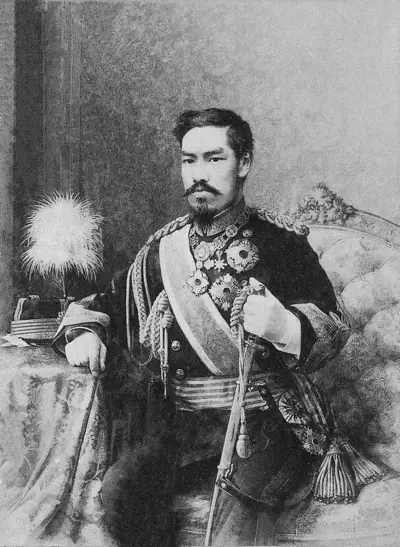
Emperor Meiji, also called Meiji the Great (明治大帝, Meiji-taitei), or Meiji the Good (明治聖帝, Meiji-seitei), was the 122nd Emperor of Japan according to the traditional order of succession, reigning from 3 February 1867 until his death on 30 July 1912, and the first monarch of the Empire of Japan. He presided over the Meiji era, a time of rapid change that witnessed Japan's transformation from an isolationist, feudal state to an industrialized world power.
