Bernardo O'Higgins Quotes
I know nothing of these torturous arts by which a man may aspire to govern a state torn by envy, parties, and factions. This evil is almost always unavoidable in newly fledged governments, which must look to themselves for sustenance and growth
The newly independent South American nations all had terrible problems and although leaders like O’Higgins were democratic by instinct and desire, they had to use non democratic means to survive and keep the governments even functioning. The factions were more than just different political parties but private armies controlled by warlords. See {584187}.
Bernardo O’Higgins, 1778-1842, 3rd Supreme Director of Chile, Letter to Jose de San Martin, Quoted in Robert Harvey, Liberators
Sourced by: Eigen's Political and Historical Quotations


Chile with help from San Martin had ejected the Spanish. O’Higgins, the Chilean leader had joined up with San Martin and served under his command. The sectional rivalry bothered men like Carrera. Instead of seeing all the South Americans fighting the Spanish as allies as O’Higgins did, Carrera and his brothers refused to join a government of unity and they and their troops were just as dictatorial and cruel as the Spanish had been. O’Higgins gave Indians and Blacks equal rights with whites which distressed the aristocratic Carrera’s. Finally the Carrera’s tried to set up their own government, and the new Chilean government disarmed their militia and executed two of the three Carrera brothers who were leading the militia troops who were little more than thieves and brigands.


In the struggle for political power, this is often forgotten. During the Barak Administration, the President proposed measures that had been introduced and supported by his Republican opponents earlier. But they then not only failed to support them but often filibustered in the Senate to block them. The Democrats failed to support some of their ideas when President Eisenhower introduced them.


A military junta had seized power because the electorate had elected a President not in military favor.

The United States had then only existed for about 30 years but was already a model.


From the 1787 Philadelphia discussions on the Constitution right up to the Civil War there was compromise after compromise on the slavery issue. Many political issues are amenable to compromise like tax rates or election modalities. Others like freedom of religion and speech and slavery are not. With the latter, compromise just delays the inevitable and often makes the final resolution more contentious and often violent.

“Collegiate management” referred to a government central finance department that would be managed by committees of politicians and/or experts for the entire country. What Google feared was that elites like bankers and merchants would dominate and control the finances of the new government. He preferred to keep most of the financial management at the provincial and city governmental level. Further, that management by committee was inefficient and often produced gridlock. By the 21st century virtually every nation had a central bank or ministry that managed the nation’s finances in a globalized world. And there was a central banker in charge (although the amount of authority differs by nation.) However Gogel’s concern has never been abated. Virtually every country had evolved to where the nation’s finances were operated and/or controlled by elite minorities. The technical and educational requirements forced that to happen.

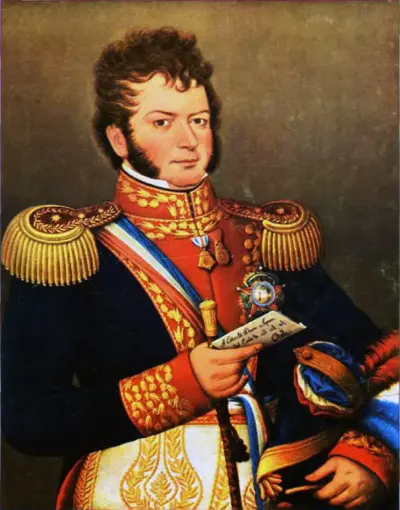
- Born: August 20, 1778
- Died: October 24, 1842
- Nationality:
- Profession: Head State, Military
Bernardo O'Higgins Riquelme (Spanish pronunciation: [beɾˈnaɾðo oˈ(x)iɣins] (listen); 1778–1842) was a Chilean independence leader who freed Chile from Spanish rule in the Chilean War of Independence. He was a wealthy landowner of Spanish and Irish ancestry. Although he was the second Supreme Director of Chile (1817–1823), he is considered one of Chile's founding fathers, as he was the first holder of this title to head a fully independent Chilean state.
